Introduction: Aluminium QCO 2026 and BIS Certification Requirement
The Government of India has notified the Aluminium and Aluminium Alloy Products (Quality Control) Order, 2026, making BIS certification for aluminium products mandatory for specified categories. This update replaces the earlier 2025 order and expands the scope of compliance across the aluminium sector.
Under this order, products must conform to applicable Indian Standards and carry the ISI mark for aluminium products before they can be manufactured, imported, or sold in India. The requirement applies to both domestic manufacturers and foreign manufacturers supplying products to the Indian market.
This regulatory change is particularly important for industries such as construction, electrical, packaging, and engineering, where aluminium products are widely used. Ensuring compliance with BIS standards helps maintain product quality, safety, and consistency across the market.
With the implementation of Aluminium QCO 2026, businesses must ensure timely BIS registration for aluminium products to maintain compliance, avoid regulatory risks, and ensure uninterrupted operations in India.
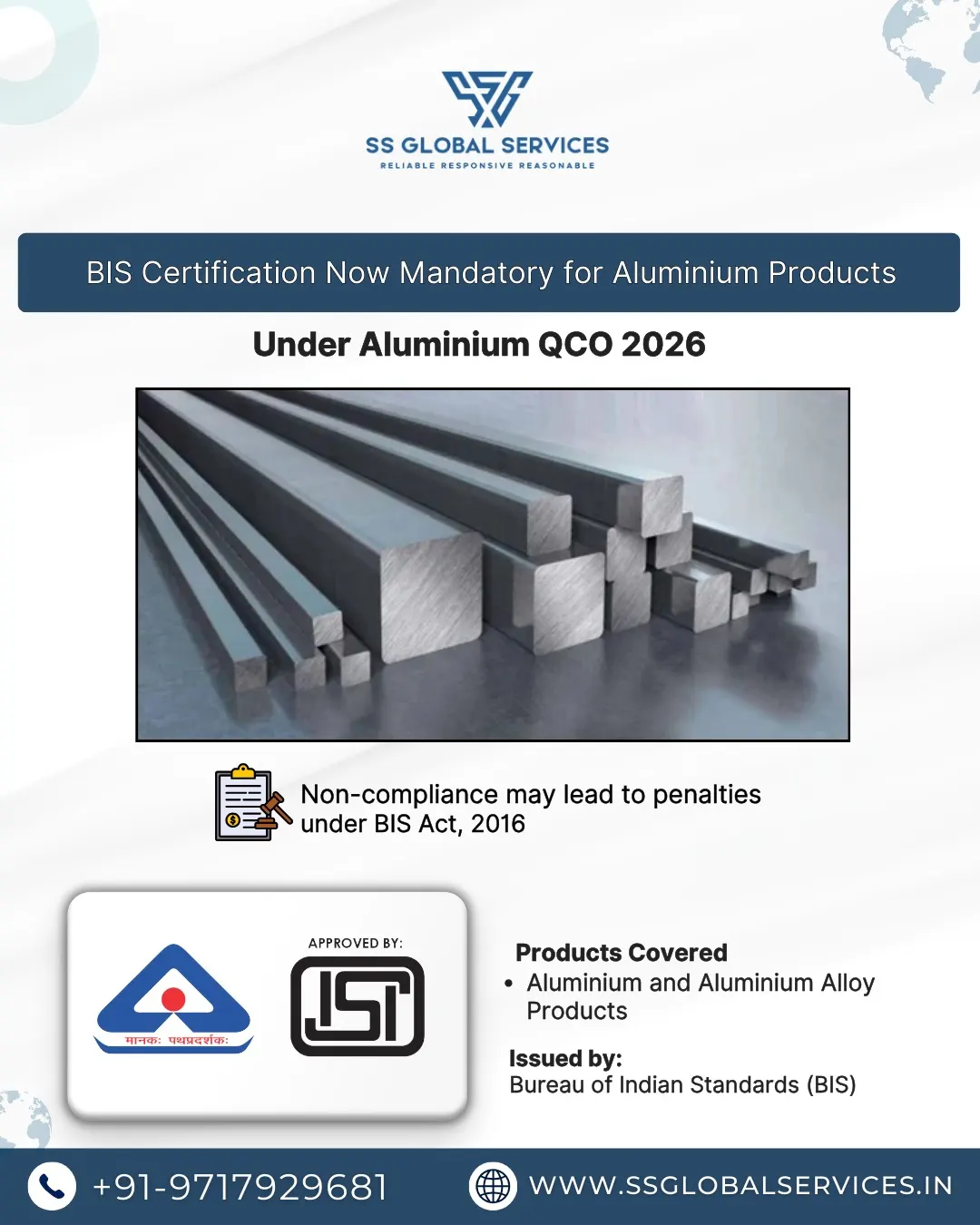
Key Highlights of the Aluminium QCO 2026 Update
- Issued by: Government of India (Ministry of Commerce & Industry - DPIIT)
- Authority: Bureau of Indian Standards (BIS))
- Order Name: Aluminium and Aluminium Alloy Products (Quality Control) Order, 2026
- Applicable Certification: BIS Certification under ISI Mark Scheme
- Implementation Type:Immediate and Phased Implementation
- Product Coverage: Aluminium and Aluminium Alloy Products (as per notified IS standards)
- Mandatory Requirement: ISI Mark for Aluminium Products before sale in India
- Applicability: Manufacturers (Domestic & Foreign) and Importers
- Exemptions: Export Products and Limited R&D Imports (up to 200 kg per year)
- Penalty: As per BIS Act, 2016 for non-compliance
View Official Notification
What is the Aluminium and Aluminium Alloy Products (Quality Control) Order, 2026?
The Aluminium and Aluminium Alloy Products (Quality Control) Order, 2026 is a regulatory notification issued by the Government of India to ensure that aluminium products manufactured, imported, and sold in the country meet defined quality and safety standards.
This order has been introduced under the provisions of the BIS Act, 2016, and makes BIS certification for aluminium products mandatory for specified categories. It replaces the earlier 2025 order and expands the scope of regulated products across the aluminium sector.
Under this QCO, all notified products must conform to the applicable Indian Standards (IS) and obtain a valid BIS license to use the ISI mark for aluminium products. Without this certification, products cannot be legally manufactured, imported, or sold in India.
In simple terms, the Aluminium QCO 2026 establishes a mandatory compliance framework for aluminium and aluminium alloy products, ensuring consistent product quality, standardization, and reliability across industries in India.
Why BIS Certification is Mandatory for Aluminium Products in India
The requirement of BIS certification for aluminium products has been introduced to ensure that only quality-compliant and safe materials are available in the Indian market. Aluminium is widely used in critical sectors such as construction, electrical systems, packaging, and engineering, where product quality directly impacts safety and performance.
Through the Aluminium and Aluminium Alloy Products (Quality Control) Order, 2026, the government has made it mandatory for specified products to meet Indian Standards and obtain certification under the ISI Mark scheme. This ensures uniformity in product quality and helps eliminate the circulation of substandard or non-compliant materials.
Key reasons for making BIS certification mandatory include:
- Quality Assurance: Ensures aluminium and aluminium alloy products meet defined Indian Standards.
- Consumer Safety: Reduces risks associated with poor-quality materials used in critical applications.
- Control on Substandard Imports: Prevents entry of low-quality imported products that do not meet Indian regulatory requirements.
- Standardization Across Industry: Creates a uniform compliance framework for manufacturers and importers.
- Legal Compliance Requirement: Makes ISI mark for aluminium products mandatory before sale in India.
In simple terms, BIS certification under this QCO ensures that aluminium products in India are reliable, standardized, and safe for use across industries.
Get Service NowProducts Covered Under Aluminium QCO 2026
The Aluminium and Aluminium Alloy Products (Quality Control) Order, 2026 specifies a list of products that must comply with Indian Standards and obtain BIS certification for aluminium products under the ISI Mark scheme.
Below is the official list of notified products along with their respective standards and implementation timelines:
| Sl. No. | Indian Standard (IS) | Title of Indian Standard | General Implementation | Small Enterprises | Micro Enterprises |
|---|---|---|---|---|---|
| 1 | IS 7092 (Part 1):1992 | Aluminium alloy tubes for irrigation purposes - welded tubes | Immediate | Immediate | Immediate |
| 2 | IS 7092 (Part 2):1987 | Aluminium alloy tubes for irrigation purposes - extruded tubes | Immediate | Immediate | Immediate |
| 3 | IS 5484:1997 | EC Grade Aluminium Rod produced by continuous casting and rolling | Immediate | Immediate | Immediate |
| 4 | IS 16011:2012 | Aluminium and aluminium alloy foil for pharmaceutical packaging | Immediate | Immediate | Immediate |
| 5 | IS 17682:2021 | Aluminium composite panel | Immediate | Immediate | Immediate |
| 6 | IS 1254:2007 | Corrugated aluminium sheet | Immediate | Immediate | Immediate |
| 7 | IS 7902:2001 | Aluminium alloy forging stock and forgings (Alloy 24345) for aerospace applications | Immediate | Immediate | Immediate |
| 8 | IS 733:1983 | Wrought aluminium and aluminium alloy bars, rods and sections (general engineering) | 01 Dec 2026 | 01 Mar 2027 | 01 Jun 2027 |
| 9 | IS 734:1975 | Wrought aluminium and aluminium alloys forging stock and forgings (general engineering) | 01 Dec 2026 | 01 Mar 2027 | 01 Jun 2027 |
| 10 | IS 736:1986 | Wrought aluminium and aluminium alloy plate for general engineering | 01 Dec 2026 | 01 Mar 2027 | 01 Jun 2027 |
| 11 | IS 737:2008 | Wrought aluminium and aluminium alloy sheet and strip for general engineering | 01 Dec 2026 | 01 Mar 2027 | 01 Jun 2027 |
| 12 | IS 739:1992 | Wrought aluminium and aluminium alloy wire for general engineering | 01 Dec 2026 | 01 Mar 2027 | 01 Jun 2027 |
| 13 | IS 740:1977 | Wrought aluminium and aluminium alloy rivet stock for general engineering | 01 Dec 2026 | 01 Mar 2027 | 01 Jun 2027 |
| 14 | IS 1285:2002 | Wrought aluminium and aluminium alloys - extruded round tube and hollow sections | 01 Dec 2026 | 01 Mar 2027 | 01 Jun 2027 |
| 15 | IS 2067:1975 | Wrought aluminium wire for electrical purposes | 01 Dec 2026 | 01 Mar 2027 | 01 Jun 2027 |
| 16 | IS 21:1992 | Wrought aluminium and aluminium alloys for manufacture of utensils | 01 Dec 2026 | 01 Mar 2027 | 01 Jun 2027 |
| 17 | IS 5082:1998 | Wrought aluminium and aluminium alloy bars, rods, tubes, sections, plates and sheets for electrical applications | 01 Dec 2026 | 01 Mar 2027 | 01 Jun 2027 |
BIS Certification Requirement for Aluminium Products (ISI Mark)
Under the Aluminium and Aluminium Alloy Products (Quality Control) Order, 2026, BIS certification for aluminium products is mandatory for all notified items. Products must comply with the relevant Indian Standards (IS) and carry the ISI mark for aluminium products before they can be manufactured, imported, or sold in India.
This requirement applies to both domestic manufacturers and foreign manufacturers supplying products to the Indian market through importers.
Key Requirements:
- Mandatory BIS License under ISI Mark Scheme (Scheme-I)
- Compliance with applicable Indian Standards (IS)
- Product testing from BIS-recognized laboratories
- Factory inspection before certification approval
Note: Without valid BIS registration for aluminium products, businesses cannot legally sell or import these products in India.
Implementation Timeline & Applicability
The Aluminium QCO 2026 introduces both immediate and phased implementation timelines depending on the product category and type of enterprise. Businesses must carefully check which timeline applies to their products to ensure timely compliance.
Implementation Timeline:
- Immediate Implementation: Certain products (such as tubes, rods, foils, panels, and sheets) require immediate BIS certification from the date of notification.
- Phased Implementation (for remaining products):
- 1 December 2026 - Applicable for general (large) manufacturers
- 1 December 2026 - Applicable for general (large) manufacturers
- 1 December 2026 - Applicable for general (large) manufacturers
Applicability:
- This order applies to:
- Domestic Manufacturers: producing aluminium and aluminium alloy products.
- Foreign Manufacturers: exporting products to India.
- Importers: dealing in notified aluminium products.
Note: Importantly, foreign manufacturers must obtain BIS certification for aluminium products, and importers must ensure compliance before importing into India.
Contact Our BIS ExpertExemptions Under the Aluminium QCO 2026 (Export and R&D Use)
The Aluminium QCO 2026 provides limited exemptions for specific cases where full compliance is not required.
Key Exemptions:
- Export-Oriented Products: Aluminium products manufactured exclusively for export are not required to obtain BIS certification for aluminium products.
- Research & Development (R&D): Imports up to 200 kg per year are allowed without BIS certification for testing, research, and development purposes.
Conditions:
- Products must not be sold commercially.
- Must be disposed of as scrap after use
- Proper records must be maintained
These exemptions are strictly controlled and should not be considered alternatives to compliance.
Impact on Manufacturers, Importers, and Businesses
The implementation of Aluminium QCO 2026 has a direct impact on the entire aluminium supply chain in India.
Key Impacts:
- Manufacturers: Must obtain BIS certification for aluminium products and align production with Indian Standards.
- Importers: Can only import products that are BIS-certified. Non-compliant shipments may be restricted.
- Supply Chain: Increased focus on quality and standardization across industries.
- MSMEs: Given phased timelines, but early preparation is essential.
Overall, this order makes aluminium products compliance in India a mandatory requirement for market access.
Get Service NowPenalties for Non-Compliance under BIS Act, 2016
Failure to comply with the requirements of the Aluminium and Aluminium Alloy Products (Quality Control) Order, 2026 can result in serious legal and business consequences. Since BIS certification for aluminium products is now mandatory, any manufacturer or importer dealing in non-certified products is considered to be in violation of the law.
The Bureau of Indian Standards (BIS) has the authority to take strict enforcement action to ensure compliance across the market. Non-compliance not only affects legal standing but can also disrupt business operations, supply chains, and market access.
Possible Consequences:
- Monetary Penalties
- Product Seizure from Market
- Ban on Manufacturing or Sale
- Legal Action against the Business
Without valid BIS registration for aluminium products, businesses cannot legally manufacture, import, or sell the notified products in India.
Step-by-Step Process for BIS Certification of Aluminium Products
Obtaining BIS certification for aluminium products under the ISI Mark Scheme involves a defined process that ensures compliance with applicable Indian Standards. Manufacturers must follow this process to get approval for using the ISI mark for aluminium products in India.
The certification process includes documentation, product testing, factory inspection, and approval by BIS authorities. Timely and accurate submission at each stage is important to avoid delays.
Certification Process:
- Application Submission: Submit the BIS application along with required documents and product details.
- Product Testing: Samples are tested as per applicable Indian Standards in BIS-recognized laboratories.
- Factory Inspection: BIS officials inspect the manufacturing facility to verify production and quality control systems.
- Grant of License: After successful verification, BIS grants the license to use the ISI mark for aluminium products.
- Ongoing Compliance: Regular surveillance and quality checks are conducted by BIS to ensure continued compliance.
How SS Global Services Can Help You
SS Global Services provides complete support for BIS certification for aluminium products under the Aluminium QCO 2026. We assist manufacturers and importers in understanding compliance requirements and completing the certification process smoothly.
Our team ensures that every step - from product evaluation to final approval - is handled efficiently, helping businesses avoid delays, rejections, and compliance risks.
Our Services Include:
- Product Applicability Assessment
- Documentation Support
- Testing Coordination with BIS-Approved Labs
- BIS Application Filing and Follow-up
- End-to-End Certification Assistance

We help businesses achieve fast and hassle-free BIS registration in India, ensuring timely compliance with all regulatory requirements.
Conclusion
The Aluminium and Aluminium Alloy Products (Quality Control) Order, 2026 marks a significant step towards strengthening quality standards and regulatory compliance in India.
With the mandatory ISI mark for aluminium products, manufacturers and importers must ensure that their products meet the applicable Indian Standards before entering the market. This shift makes BIS certification for aluminium products an essential requirement rather than an option.
Early preparation and timely certification will help businesses avoid disruptions, ensure compliance, and maintain uninterrupted market access in India.
Read Also
Read the Official BIS Notification on Aluminium QCO 2026 and Aluminium Alloy Products in India
Frequently Asked Questions (FAQs)
Request Service Today!
Ready to get certified or need expert compliance support? Fill out the form below and our team at SS Global Services will connect with you shortly.
We offer fast, reliable, and hassle-free assistance for all BIS and regulatory certification needs.