Overview of BEE Energy Audit Regulations
The BEE Energy Audit Regulations 2026 introduce a structured framework to improve how electricity distribution companies (DISCOMs) manage, monitor, and report energy usage across India. Issued by the Bureau of Energy Efficiency (BEE), these regulations aim to bring greater transparency, accountability, and efficiency in the power distribution sector.
Under this new framework, DISCOMs are required to follow a data-driven approach for tracking energy flow, identifying losses, and improving operational performance. The regulations emphasize regular monitoring through mandatory energy audits and quarterly energy reporting, ensuring that inefficiencies are identified and addressed on time.
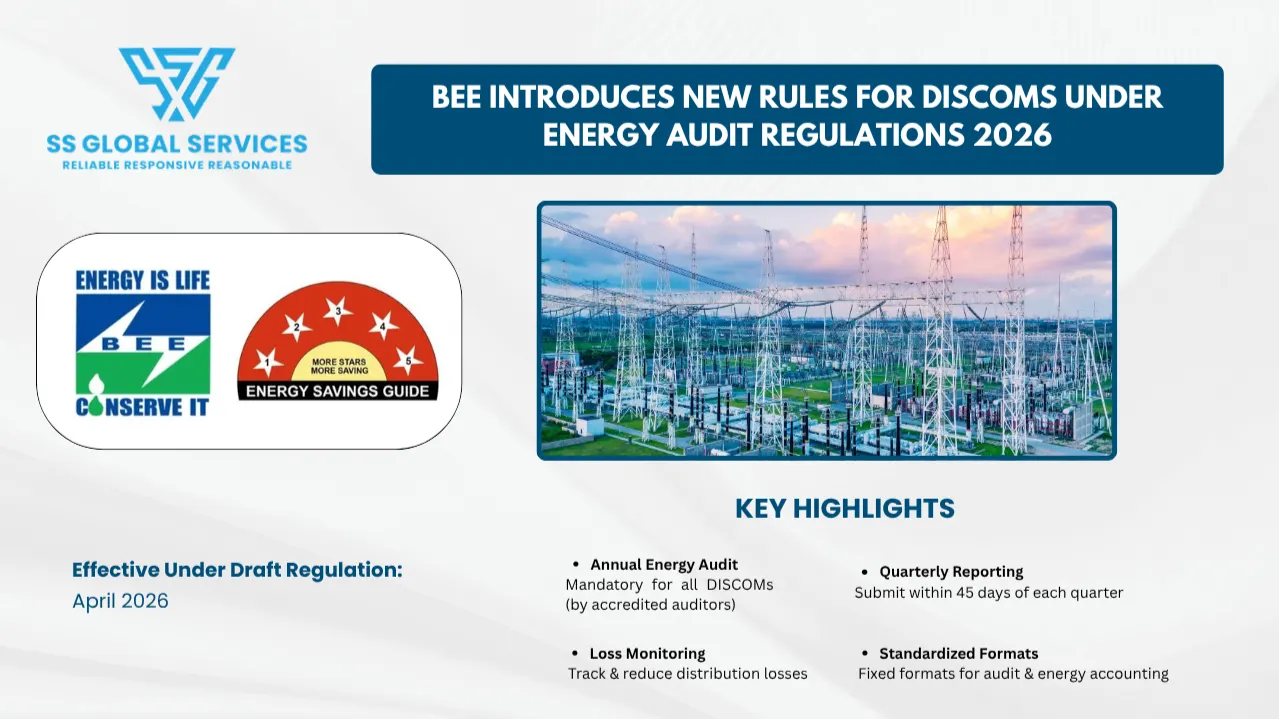
Key Highlights of BEE DISCOM Regulations 2026
- Issued By: Bureau of Energy Efficiency (BEE), Government of India
- Issue Date: 15 April 2026
- Reference: Supersedes earlier BEE notifications issued in 2021 and 2022
- Subject: Mandatory Energy Audit & Energy Accounting Framework for DISCOMs
- Regulation Applicable: BEE Energy Audit & Energy Accounting Regulations 2026
-
Entities Covered:
- Key Requirement 1: Annual Energy Audit to be conducted through accredited energy auditors
- Key Requirement 2: Quarterly Energy Reporting within 45 days of each quarter
- Key Requirement 3: Mandatory Monitoring and Reduction of Distribution Losses
- Reporting Framework: Standardized formats (Annexures) prescribed by BEE
- Purpose: To improve energy efficiency, transparency, and reduce power distribution losses
- Regulation Status: Draft Notification (open for public comments)
What are BEE Energy Audit Regulations 2026?
The BEE Energy Audit Regulations 2026 are a new set of rules introduced by the Bureau of Energy Efficiency (BEE) to improve how electricity distribution companies (DISCOMs) manage and monitor energy usage in India. These regulations establish a structured framework for energy auditing and energy accounting, making it mandatory for DISCOMs to regularly track their energy flow, consumption patterns, and distribution losses. The goal is to ensure that energy is used efficiently and any losses or inefficiencies are properly identified and addressed.
Under the BEE Energy Accounting Rules 2026, DISCOMs are required to maintain accurate data related to energy input, billing, and consumption across different consumer categories and voltage levels. This data must then be analyzed through periodic reporting and annual audits.
One of the key aspects of these regulations is the shift toward continuous monitoring instead of one-time compliance. With the introduction of quarterly reporting and standardized formats, DISCOMs are expected to maintain ongoing visibility into their operations.
Overall, the Energy Audit Rules India 2026 aim to create a more transparent, accountable, and performance-driven power distribution system, helping reduce energy losses and improve overall efficiency in the sector.
Talk With BIS ExpertWho Needs to Comply with BEE DISCOM Regulations 2026?
The BEE DISCOM Regulations 2026 are applicable to all electricity distribution companies that fall under the category of designated consumers as defined by the Bureau of Energy Efficiency (BEE).
This includes both government-owned and private DISCOMs involved in power distribution across India. Any organization responsible for supplying electricity to end users and operating within the regulated distribution network must comply with these requirements.
The objective is to ensure that all DISCOMs follow a standardized framework for energy audit, energy accounting, and reporting, creating consistency and transparency across the sector.
Entities Covered Under These Regulations:
- State-owned electricity distribution companies (DISCOMs)
- Private electricity distribution companies
- Joint venture or franchise-based distribution entities
- Any DISCOM notified as a designated consumer by BEE
Compliance Applicability Includes:
- Urban and rural electricity distribution networks
- High tension (HT) and low tension (LT) distribution systems
- All consumer categories (domestic, commercial, industrial, etc.)
By bringing all these entities under one framework, the regulation strengthens power distribution compliance in India and ensures that energy performance is monitored uniformly.
In simple terms, if your organization is involved in electricity distribution and falls under BEE’s designated consumer category, compliance with these regulations is mandatory.
Key Compliance Requirements Under BEE DISCOM Regulations 2026
The BEE DISCOM Regulations 2026 establish a comprehensive compliance framework that requires electricity distribution companies to adopt a more structured, transparent, and data-driven approach to energy management. These requirements are designed to ensure that DISCOMs continuously monitor their performance, accurately report data, and take corrective actions to reduce energy losses.
Unlike earlier practices, compliance is no longer limited to periodic checks. DISCOMs are now expected to follow a system of regular auditing, continuous reporting, and ongoing performance evaluation.
Mandatory Annual Energy Audit
Every DISCOM must conduct a detailed energy audit for each financial year through a BEE-accredited energy auditor. This audit focuses on analyzing energy flow, identifying inefficiencies, and highlighting areas of improvement.
- Must be conducted by an accredited energy auditor
- Covers energy consumption, losses, and system performance
- Report to be submitted within 4 months after financial year end
This ensures structured evaluation under mandatory energy audit requirements for DISCOMs in India.
Quarterly Energy Reporting Requirement
To enable continuous monitoring, DISCOMs must carry out quarterly energy accounting and reporting.
- Reports to be prepared for every quarter
- Submission required within 45 days of quarter closure
- Includes energy input, billing, and consumption data
This supports BEE quarterly energy reporting requirements for DISCOMs.
Energy Loss Monitoring and Reduction
A key focus of the regulation is the identification and reduction of distribution losses, including both technical and commercial losses.
- Track energy leakage and inefficiencies
- Analyze loss areas across the network
- Implement corrective actions for improvement
This helps achieve DISCOM energy loss reduction and better efficiency.
Standardized Reporting Formats
BEE has introduced uniform reporting formats (Annexures) to ensure consistency in data submission across all DISCOMs.
- Annexure-II for quarterly energy accounting
- Annexure-III for annual energy audit reports
- Covers consumer data, metering, and voltage-wise losses
This ensures compliance under BEE energy accounting rules 2026.
Data Monitoring, Verification & Record Keeping
DISCOMs are required to maintain accurate records and ensure proper data validation.
- Ensure data consistency and accuracy
- Maintain all supporting documents and reports
- Provide data for verification when required
This strengthens data-driven compliance and accountability.
Get Service NowEnergy Accounting Requirements for DISCOMs in India
Under the BEE Energy Accounting Rules 2026, DISCOMs are required to implement a structured and detailed energy accounting system to track the complete flow of electricity across their distribution network. This is a critical component of the regulation, as accurate energy accounting helps in identifying inefficiencies, improving billing accuracy, and reducing distribution losses.
Unlike earlier practices, compliance is no longer limited to periodic checks. DISCOMs are now expected to follow a system of regular auditing, continuous reporting, and ongoing performance evaluation.
Tracking of Energy Input, Consumption & Losses
DISCOMs must maintain accurate records of energy flow across the distribution network to ensure proper energy accounting and loss identification.
- Total energy input received at the distribution level (in Million Units - MU)
- Total billed energy across all consumer categories
- Distribution losses, calculated as the difference between input and billed energy
This forms the foundation of energy accounting requirements for DISCOMs in India.
Consumer-Level Energy Data
Detailed tracking of consumer data is mandatory to understand consumption patterns and improve billing efficiency.
- Number of metered and unmetered consumers
- Segregation of consumers into categories such as:
- Domestic
- Commercial
- Industrial (LT & HT)
- Others
This helps in identifying gaps in metering and revenue loss.
Voltage-Wise Energy Flow Monitoring
DISCOMs are required to monitor energy flow across different voltage levels within the distribution network.
- Low Tension (LT)
- 11 kV / 22 kV
- 33 kV
- Above 33 kV
This enables better identification of loss points within the distribution system.
Metering Infrastructure & Network Data
The regulation requires detailed reporting on metering infrastructure and network components.
- Percentage of metering at consumer level
- Percentage of metering at feeder level
- Status of distribution transformers (DTs)
This ensures improved data accuracy and system reliability.
Performance Indicators & Loss Analysis
DISCOMs must regularly evaluate key performance metrics to improve operational efficiency and reduce losses.
- Distribution losses (%)
- Billing efficiency (%)
- Energy balance across the network
This supports effective decision-making and operational improvements.
Standardized Reporting Format
All energy accounting data must be reported as per the Annexure-II format prescribed by BEE.
- Ensures uniform reporting across all DISCOMs
- Enables better comparison and regulatory monitoring
- Strengthens compliance under power distribution regulations in India
Overall, the energy accounting requirements under the BEE DISCOM Regulations 2026 ensure that DISCOMs maintain accurate, transparent, and structured data, which is essential for improving efficiency and reducing energy losses.
Get Service NowHow to Comply with BEE Regulations for DISCOMs
Complying with the BEE DISCOM Regulations 2026 requires a well-structured and systematic approach. Since the regulation introduces mandatory energy audits, quarterly reporting, and continuous monitoring, DISCOMs need to align their internal processes with these requirements.
To ensure smooth compliance, organizations must focus on accurate data collection, timely reporting, and proper audit execution. A step-by-step approach can help DISCOMs meet regulatory expectations efficiently while also improving operational performance.
- Step 1: Appoint an Accredited Energy Auditor: The first step is to appoint a BEE-accredited energy auditor who will conduct the annual energy audit. The auditor will evaluate energy flow, identify inefficiencies, and provide recommendations for improvement.
- Step 2: Establish a Strong Data Collection System: DISCOMs must set up systems to collect accurate data related to energy input, consumption, and losses. This includes tracking data at consumer, feeder, and transformer levels to ensure complete visibility.
- Step 3: Perform Quarterly Energy Accounting: Energy accounting must be carried out on a quarterly basis, and reports should be prepared as per the prescribed format. These reports must be submitted within 45 days of each quarter, ensuring continuous monitoring.
- Step 4: Conduct Annual Energy Audit: A detailed energy audit must be conducted every financial year. The audit report should include analysis of energy usage, loss areas, and improvement strategies, and must be submitted within the specified timeline.
- Step 5: Monitor and Reduce Distribution Losses: DISCOMs need to actively identify areas of energy loss and implement corrective actions. This includes improving metering systems, reducing leakages, and enhancing overall network efficiency.
- Step 6: Maintain Records and Ensure Data Accuracy: All data, reports, and supporting documents must be properly maintained. Ensuring data accuracy and consistency is critical, as these records may be reviewed by regulatory authorities.
- Step 7: Seek Expert Support for Compliance: To simplify the process, DISCOMs can also take support from professionals offering energy audit services, compliance consulting, and reporting solutions. This helps in ensuring error-free and timely compliance.
Official BEE Notification
The BEE Energy Audit Regulations 2026 have been introduced through an official draft notification issued by the Bureau of Energy Efficiency (BEE) under the Ministry of Power, Government of India. This notification outlines the proposed regulatory framework for energy audit and energy accounting requirements applicable to DISCOMs
Conclusion
The BEE DISCOM Regulations 2026 mark an important shift in how electricity distribution companies manage and monitor energy across their networks. By making energy audits, quarterly reporting, and loss monitoring mandatory, the regulation introduces a more structured and accountable approach to energy management.
For DISCOMs, this means moving beyond traditional practices and adopting a data-driven compliance system. Regular tracking of energy flow, accurate reporting, and timely audits will now play a crucial role in ensuring regulatory compliance and improving operational efficiency.
At the same time, these regulations also create an opportunity for DISCOMs to identify inefficiencies, reduce distribution losses, and enhance overall performance. Organizations that implement these requirements effectively will be better positioned to improve billing efficiency, reduce energy wastage, and strengthen their operational systems.
Read Also
Frequently Asked Questions (FAQs)
Request Service Today!
Ready to get certified or need expert compliance support? Fill out the form below and our team at SS Global Services will connect with you shortly.
We offer fast, reliable, and hassle-free assistance for all BIS and regulatory certification needs.