INTRODUCTION
The surveillance industry is rapidly evolving with the growing use of AI-based monitoring systems and face recognition technologies. As CCTV systems become more intelligent, the need for structured guidelines and reliable performance standards has become increasingly important.
To address this, the Bureau of Indian Standards (BIS) has introduced new standards for CCTV systems with face recognition capabilities, bringing more clarity to how these systems should be designed, tested, and implemented. This update focuses on improving accuracy, data validation, and overall system reliability in biometric surveillance.
In simple terms, this update marks a shift from traditional surveillance to standardized and intelligent CCTV systems, where performance and compliance play a crucial role.
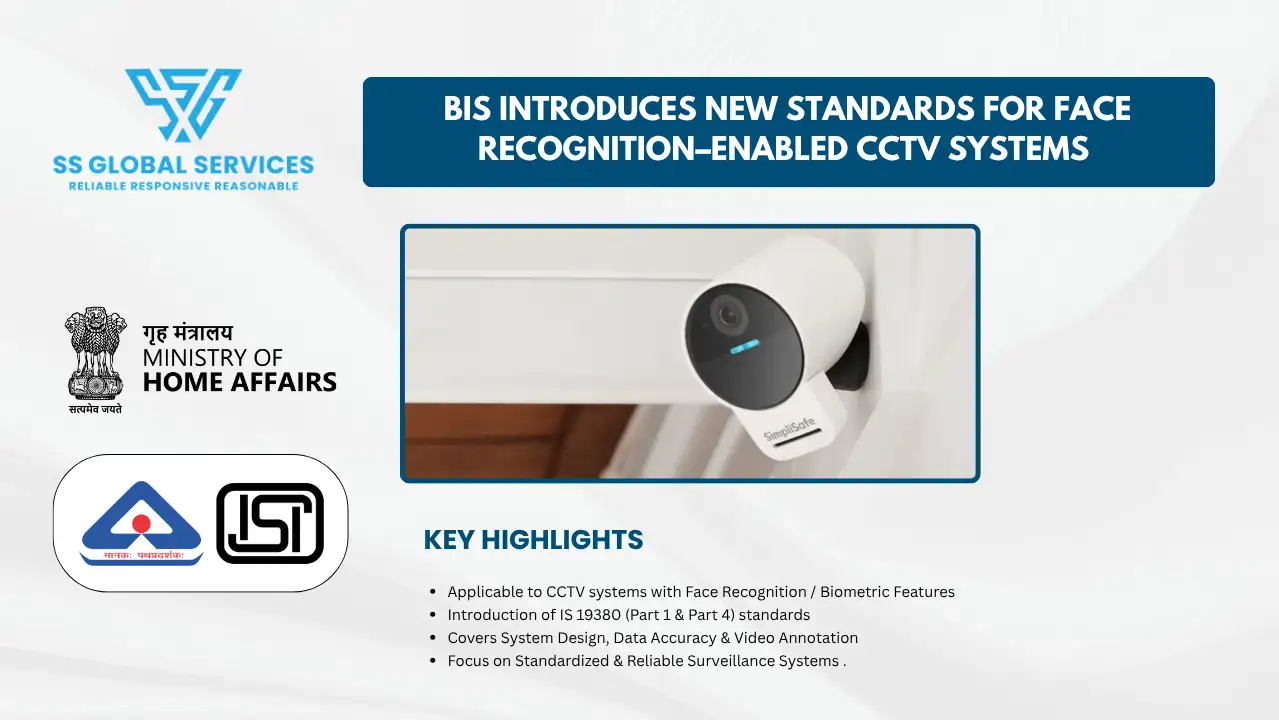
Key Highlights of BIS CCTV Standards Update
- Issued By: Bureau of Indian Standards (BIS)
- Subject: Introduction of Standards for Face Recognition in CCTV Systems
- Applicable To: CCTV Systems with Face Recognition / Biometric Features
- Standards Introduced: IS 19380 (Part 1 & Part 4)
- Scope: Use of Biometrics in Video Surveillance Systems
- Focus Areas: System Design, Data Validation & Video Annotation
- Technology Covered: AI-Based Monitoring & Biometric Surveillance Systems
- Procurement Impact: Preferred for Government CCTV Projects
- Compliance Status: Not Fully Mandatory (Reference Standard)
- Effective From: 30 October 2025
What is the BIS CCTV Standards Update?
The BIS CCTV standards update focuses on introducing a structured framework for CCTV systems that use face recognition and biometric technologies. With the increasing adoption of AI-based surveillance, there was a need to define clear guidelines for how these systems should function, process data, and deliver accurate results.
Through this update, the Bureau of Indian Standards (BIS) has introduced the IS 19380 series, which specifically addresses the use of biometrics in video surveillance systems. These standards help ensure that CCTV systems are not just technologically advanced, but also reliable, consistent, and compliant with defined benchmarks.
- Bring standardization in face recognition CCTV systems
- Improve accuracy and performance of biometric surveillance
- Define how systems should handle data, validation, and processing
- Create a uniform approach across manufacturers and solution providers
Earlier, many surveillance systems operated without a clearly defined structure for biometric features. This often led to inconsistencies in performance and data reliability. With the introduction of these standards, BIS is setting a foundation for more controlled and quality-driven deployment of surveillance systems.
Overall, this update is not just about adding new rules — it is about shaping the future of AI-driven surveillance with a focus on compliance, accuracy, and trust.
Talk With BIS ExpertList of BIS Standards for CCTV & Surveillance Systems
The IS 19380 standard is the core part of this update and focuses on how biometric-enabled CCTV systems should be designed, tested, and evaluated. It provides a structured framework to ensure that face recognition CCTV systems deliver accurate and reliable results.
This standard is divided into different parts, each addressing a specific aspect of surveillance systems:
| SI. No. | No., Year & Title of the Indian Standards Established | Date of Establishment | No., Year & Title of the Indian Standards to be Withdrawn, if any | Date of Withdrawal |
|---|---|---|---|---|
| 1 | IS 16335 : 2025 Power Control Systems — Security Requirements (First Revision) |
30 October 2025 | IS 16335 : 2015 Power Control Systems — Security Requirements |
30 April 2026 |
| 2 | IS 19380 (Part 1) : 2025 ISO/IEC 30137-1 : 2024 Information Technology — Use of Biometrics in Video Surveillance Systems Part 1 System Design and Specification |
30 October 2025 | NA | NA |
| 3 | IS 19380 (Part 4) : 2025 ISO/IEC 30137-4 : 2021 Information Technology — Use of Biometrics in Video Surveillance Systems Part 4 Ground Truth and Video Annotation Procedure |
30 October 2025 | NA | NA |
| 4 | IS/IEC 60034-27-1 : 2017 Rotating Electrical Machines Part 27 Winding Insulation of Rotating Electrical Machines Section 1 Off-Line Partial Discharge Measurements on the Winding Insulation |
30 October 2025 | NA | NA |
| 5 | IS/IEC 60034-27-2 : 2023 Rotating Electrical Machines Part 27 Winding Insulation of Rotating Electrical Machines Section 2 On-Line Partial Discharge Measurements on the Stator Winding Insulation |
30 October 2025 | NA | NA |
| 6 |
IS/IEC 60034-27-3 : 2015 Rotating Electrical Machines Part 27 Winding Insulation of Rotating Electrical Machines Section 3 Dielectric Dissipation Factor Measurement on Stator Winding Insulation of Rotating Electrical Machines |
30 October 2025 | NA | NA |
Is Face Recognition CCTV Mandatory Under BIS IS 19380?
One of the most common questions around this update is whether face recognition CCTV systems are mandatory under BIS standards, especially after the introduction of IS 19380.
The simple answer is: not fully mandatory at this stage. However, this does not mean it can be ignored. These standards are currently reference-based, but they are already influencing government procurement decisions and industry best practices.
In short, while businesses are not legally required to comply yet, aligning with IS 19380 can provide a competitive advantage and help you stay prepared for future mandatory compliance.
Current Status
- The IS 19380 standard: is currently a reference standard
- Mandatory certification: it is not yet part of any BIS scheme (like CRS or ISI)
- Legal requirement: businesses are not legally required to comply with it at this stage
Where It Becomes Important
Even though it is not mandatory, the standard is already being used in key areas:
- Government Procurement: CCTV systems with face recognition may be preferred if they align with BIS standards
- Project Approvals: standard-compliant systems are more likely to be accepted in regulated environments
What This Means for Businesses
This update clearly indicates the direction of future regulations.
- Increasing focus: on biometric surveillance compliance
- Higher importance: of standard-based product design
- Future outlook: likely transition toward mandatory requirements
What Should Businesses Do Now?
With the introduction of BIS standards for face recognition CCTV systems, businesses should start preparing early rather than waiting for mandatory enforcement. Being proactive can help avoid last-minute compliance issues and create a competitive advantage in the market.
Even though the standards are not compulsory yet, they clearly indicate the future direction of CCTV compliance and surveillance regulations.
Key Actions Businesses Should Take
- Review Existing CCTV Products: Evaluate whether your current systems support face recognition and biometric features in line with emerging standards.
- Align with IS 19380 Requirements: Understand the technical aspects of system design, data validation, and performance benchmarks defined under IS 19380.
- Strengthen Technical Documentation: Ensure proper documentation related to system architecture, data handling processes, and performance specifications.
- Focus on Data Accuracy and Validation: Improve how your systems handle biometric data and video analytics, as accuracy will be a key compliance factor.
- Prepare for Government Projects: If you are targeting public sector opportunities, aligning with BIS standards can increase your chances of approval.
- Stay Updated with Regulatory Changes: Monitor future updates, as these standards may soon become part of mandatory compliance frameworks.
Official Notification For BIS For Face Recognition
The introduction of standards for face recognition CCTV systems is based on an official notification issued through the Bureau of Indian Standards (BIS) and referenced by the Ministry of Home Affairs (MHA).
This notification formally establishes the IS 19380 series, which covers the use of biometrics in video surveillance systems and provides a structured framework for implementation.
Conclusion
The introduction of BIS standards for face recognition CCTV systems under IS 19380 marks an important step toward more structured and reliable surveillance technologies. As CCTV systems continue to evolve with AI and biometric capabilities, having clear standards helps ensure accuracy, consistency, and better system performance.
Although these standards are not fully mandatory yet, they are already influencing government procurement and industry expectations. This clearly indicates a shift toward standard-based compliance and regulated surveillance systems.
Read Also
Frequently Asked Questions (FAQs)
Request Service Today!
Ready to get certified or need expert compliance support? Fill out the form below and our team at SS Global Services will connect with you shortly.
We offer fast, reliable, and hassle-free assistance for all BIS and regulatory certification needs.