Introduction: BIS Certification for Hand Tools in India Under QCO, 2025
The Government of India has made BIS certification for hand tools mandatory under the Quality Control Order (QCO), 2025. This new regulation aims to ensure that all specified hand tools meet defined Indian Standards (IS) for quality, safety, and performance.
From 1 October 2026, manufacturers and importers will not be allowed to manufacture, sell, or distribute hand tools in India without a valid BIS certification and ISI Mark.
This update directly impacts businesses dealing in products such as spanners, wrenches, and pliers. Companies must start preparing early to comply with the new requirements and avoid disruptions in operations.
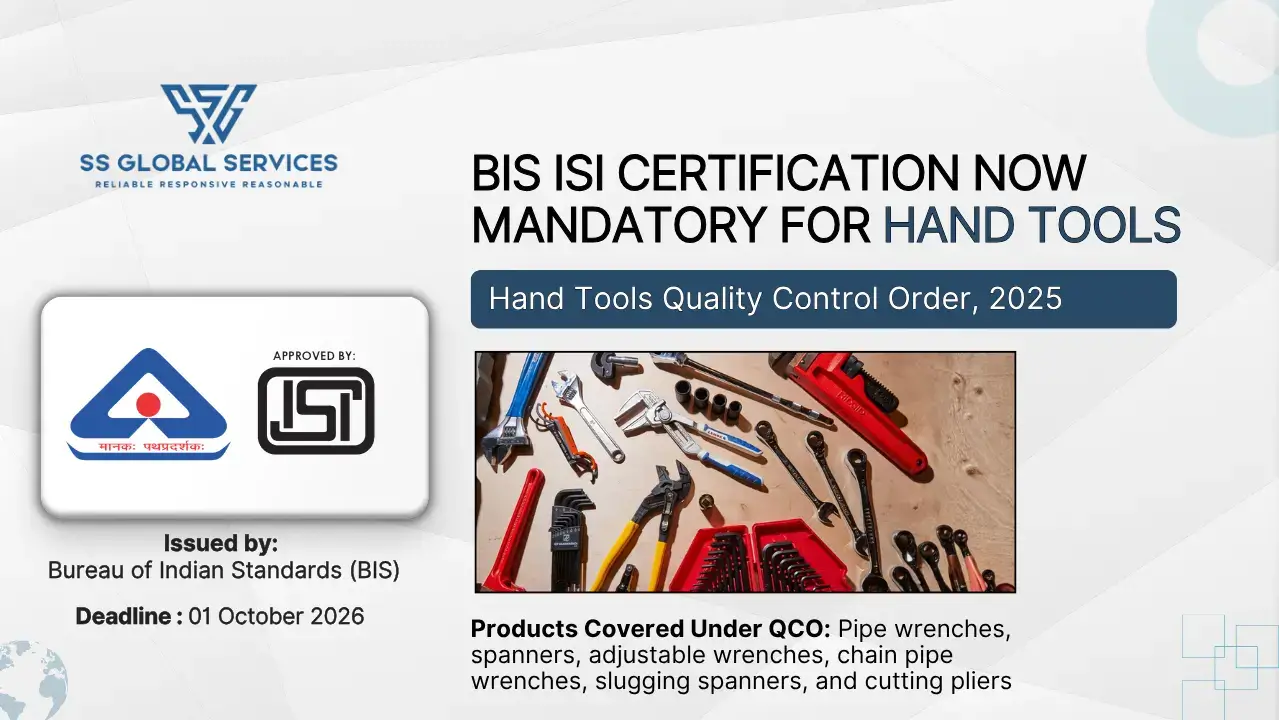
Key Highlights of the Hand Tools QCO, 2025 Update
- Issued by: Ministry of Commerce and Industry (DPIIT)
- Implemented by: Bureau of Indian Standards (BIS)
- Notification Basis: MeitY Notification dated 29 October 2025
- Applicable Scheme: BIS Scheme-I (ISI Mark Certification)
- Applicable Product Category: Hand Tools (Wrenches, Spanners, Pliers, etc.)
- Requirement Introduced: Mandatory compliance with BIS standards for manufacturing and sale
- Exemptions: Export products and limited R&D imports (up to 200 units/year)
- Effective From: 1 October 2026
View Official Notification
What is the Hand Tools Quality Control Order (QCO), 2025?
The Hand Tools Quality Control Order (QCO), 2025 is a government regulation introduced to make BIS certification for hand tools mandatory in India. It has been issued under the Bureau of Indian Standards (BIS) Act, 2016 to ensure that specified hand tools meet required Indian Standards (IS) for quality, safety, and performance.
Under this order, only those hand tools that are certified by BIS and carry the ISI Mark will be allowed to be manufactured, imported, or sold in the Indian market after the applicable deadline.
The update mainly focuses on:
- Only BIS-certified products can be manufactured or sold
- Products must carry the ISI Mark
- Certification is required under BIS Scheme-I
- To promote quality manufacturing practices
- To ensure standardization of hand tools in India
This regulation applies to common hand tools such as spanners, wrenches, and pliers, which are widely used in industrial and mechanical applications.
In simple terms, the QCO ensures that only standardized and quality-tested hand tools are available in the Indian market.
Is BIS Certification Mandatory for Hand Tools in India?
Yes, BIS certification for hand tools is mandatory in India under the Hand Tools Quality Control Order (QCO), 2025. This means that all specified hand tools must comply with applicable Indian Standards (IS) before they can be manufactured, imported, or sold in the Indian market.
The regulation has been introduced to ensure that only quality-tested and standard-compliant products are available to consumers.
What does this mean for businesses?
- BIS certification is compulsory under Scheme-I (ISI Mark)
- Products must meet relevant Indian Standards (IS codes)
- The ISI Mark must be displayed on certified products
- Certification must be obtained before sale or distribution
Who needs to comply?
- Manufacturers of hand tools in India
- Importers bringing hand tools into India
- Brand owners and sellers dealing in notified products
Non-compliance with these requirements may lead to penalties, product seizure, and restrictions on sale under the BIS Act.
Get Service NowProducts Covered Under Hand Tools QCO, 2025
The Hand Tools Quality Control Order (QCO), 2025 applies to a specific range of hand tools that are commonly used in industrial, mechanical, and maintenance applications. These products must comply with relevant Indian Standards (IS) and obtain BIS certification before being sold in India.
Covered hand tool products include:
| IS Mark Code | Standard Title | General Deadline | Small Biz Deadline | Micro Biz Deadline |
|---|---|---|---|---|
| 4003 (Part 1):1978 | Pipe Wrenches General Purpose | 1st October, 2026 | 1st January, 2027 | 1st April, 2027 |
| 4003(Part 2):1986 | Pipe Wrenches Heavy Duty | 1st October, 2026 | 1st January, 2027 | 1st April, 2027 |
| 2028:2004 | Open-Jaw Wrenched (Spanners) | 1st October, 2026 | 1st January, 2027 | 1st April, 2027 |
| 2029:1998 | Ring Wrenches (Spanners) | 1st October, 2026 | 1st January, 2027 | 1st April, 2027 |
| 6149:1984 | Single-ended Openjaw Adjustable Wrenches | 1st October, 2026 | 1st January, 2027 | 1st April, 2027 |
| 4123:1982 | Chain Pipe Wrenches | 1st October, 2026 | 1st January, 2027 | 1st April, 2027 |
| 4508:1992 | Open Ended Slugging Wrenches (Spanners) | 1st October, 2026 | 1st January, 2027 | 1st April, 2027 |
| 4509:1992 | Ring Slugging Wrenches (Spanners) | 1st October, 2026 | 1st January, 2027 | 1st April, 2027 |
| 3650:1981 | Combination Side Cutting Pliers | 1st October, 2026 | 1st January, 2027 | 1st April, 2027 |
BIS Certification Requirements for Hand Tools
To comply with the Hand Tools Quality Control Order (QCO), 2025, manufacturers must ensure that their products meet the requirements set by the Bureau of Indian Standards (BIS). Certification is granted only after proper testing and verification of the product and manufacturing process.
In simple terms, businesses must follow a structured process to obtain BIS certification before selling hand tools in India.
Key requirements
- Products must comply with applicable Indian Standards (IS)
- BIS certification is required under Scheme-I (ISI Mark Certification)
- Products must be tested in BIS-approved laboratories
- Manufacturing units must undergo factory inspection and audit
- Proper quality control measures must be maintained
What businesses should ensure
- Consistent product quality as per BIS standards
- Availability of testing reports and technical documents
- Compliance with BIS guidelines during manufacturing
Meeting these requirements is essential to obtain and maintain a valid BIS license for hand tools.
Deadline for BIS Certification for Hand Tools in India
The Government has introduced a phased implementation timeline for BIS certification under the Hand Tools QCO, 2025, giving different deadlines based on the size of the enterprise.
Businesses must ensure compliance before the applicable deadline to avoid any disruption in manufacturing or sales.
Implementation timeline:
Large & Medium Enterprises: 1 October 2026
Small Enterprises: 1 January 2027
Micro Enterprises: 1 April 2027
Important points to note:
- After the deadline, non-certified products cannot be sold in India
- BIS certification must be obtained before the applicable date
- Delay in certification may impact business operations and supply chain
It is advisable for manufacturers and importers to start the BIS certification process early to avoid last-minute delays in testing, documentation, and approvals.
Exemptions Under Hand Tools QCO, 2025
The Hand Tools Quality Control Order (QCO), 2025 makes BIS certification mandatory for hand tools in India, but it also provides limited exemptions in specific cases. These exemptions are clearly defined and apply only under controlled conditions.
It is important to understand that these relaxations are not applicable for regular commercial sale in the Indian market. Any product intended for domestic sale must comply with BIS requirements.
Key exemptions under Hand Tools QCO, 2025:
Export-Oriented Products
Hand tools manufactured exclusively for export are exempt from BIS certification. Since these products are not sold in India, the QCO requirements do not apply.
Imports for Research & Development (R&D)
Manufacturers are allowed to import up to 200 units per year for testing, research, and product development purposes.
Conditions for availing R&D exemption:
- Imported products cannot be sold commercially in India
- Usage is restricted to internal testing or development activities
- Products must be disposed of after use (e.g., scrap)
- A year-wise record of such imports must be maintained and submitted when required
Official Notification of Hand Tools QCO, 2025
The Hand Tools Quality Control Order (QCO), 2025 has been officially notified by the Government of India under the BIS Act, 2016, making BIS certification mandatory for specified hand tools.
Conclusion
The Hand Tools Quality Control Order (QCO), 2025 makes it clear that BIS certification for hand tools is now a mandatory requirement in India. Businesses dealing in covered products must ensure compliance with Indian Standards (IS) and obtain a valid BIS license with ISI Mark before the applicable deadlines.
This update directly impacts manufacturers, importers, and sellers, making early preparation essential to avoid delays in certification, testing, and approvals.