Introduction:
India’s product certification framework continues to evolve as the Bureau of Indian Standards (BIS) introduces amendments to the BIS (Conformity Assessment) Regulations, 2018. Through the BIS (Conformity Assessment) Amendment Regulations, 2026, officially notified in the Gazette of India on 25 February 2026, BIS has introduced several important compliance updates.
The amendment introduces changes such as BIS licence validity extended to 5 years, advance annual licence fee payment requirements for licence continuation, production statement submission obligations, and clearer suspension rules with late fee provisions for non-compliance.
These amendments are particularly relevant for manufacturers, importers, and businesses operating under BIS certification schemes, including those dealing with ISI Mark certification and Certificates of Conformity (CoC). Understanding these regulatory updates is essential for businesses to maintain uninterrupted compliance and smooth access to the Indian market.
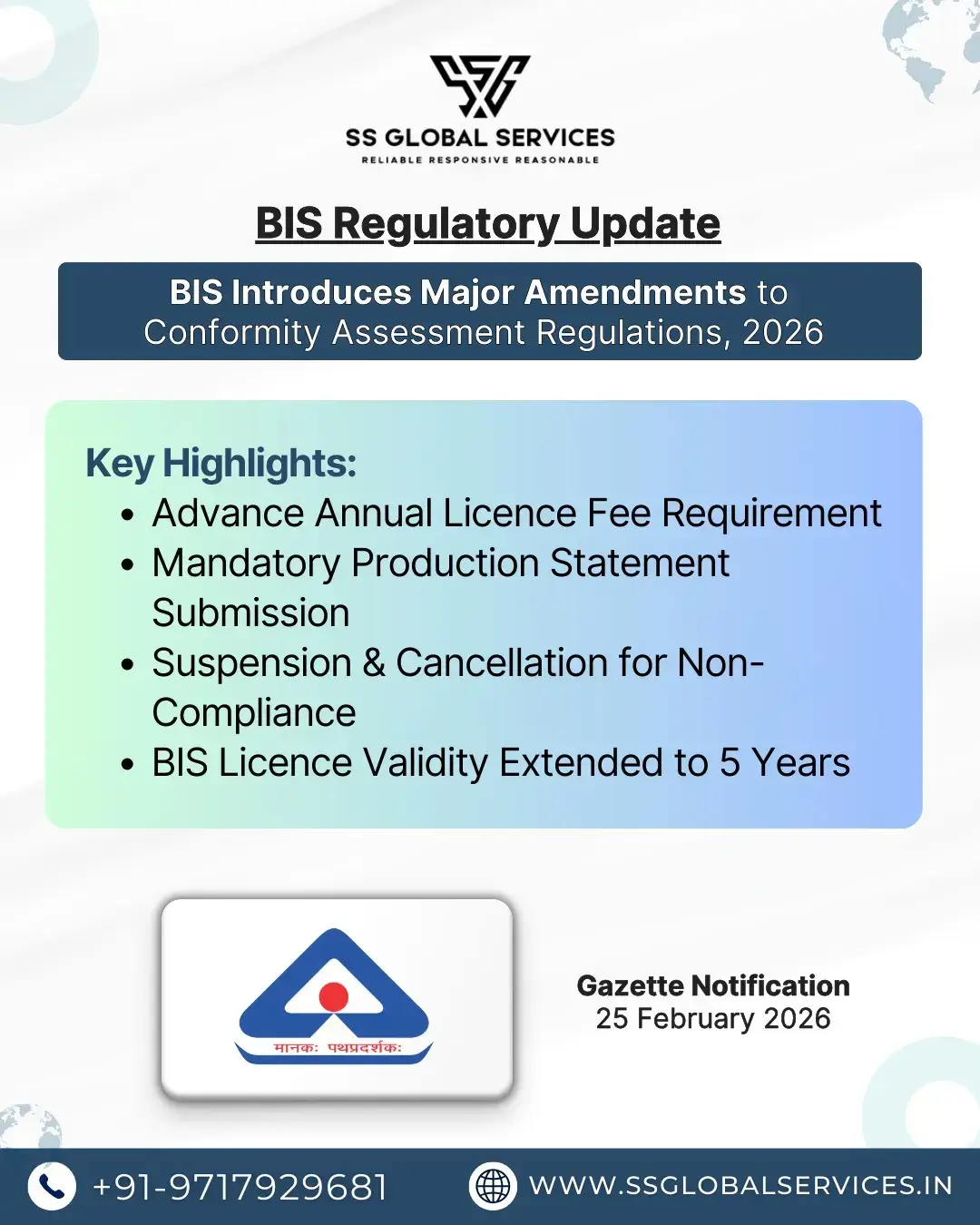
Key Highlights of the BIS Update
- Issued by: Bureau of Indian Standards (BIS)
- Amendment Name: BIS (Conformity Assessment) Amendment Regulations, 2026
- Notification Date: 25 February 2026
Key Changes Introduced:
- Licence Validity: BIS licence validity extended to 5 years.
- Annual Fee: Licence fee must be paid annually in advance.
- Production Statement: Annual production statements must be submitted.
- Late Fee: ₹5,000 late fee applicable during the suspension period.
- CoC Compliance: Same compliance rules apply to Certificate of Conformity holders.
- Objective: Strengthen compliance monitoring and regulatory transparency under BIS certification.
What Are the BIS Conformity Assessment Regulations?
The BIS Conformity Assessment Regulations form the regulatory framework that governs how products, systems, and services are evaluated for compliance with Indian Standards.
- Certification procedures
- Licensing requirements for the use of the Standard Mark (ISI Mark)
- Compliance monitoring mechanisms
- Suspension and cancellation provisions for licences
The 2026 amendment introduces procedural and compliance-related updates designed to strengthen monitoring and ensure better regulatory control.
Key Changes Introduced in BIS Amendment Regulations 2026
1. Annual Advance Fee Payment for BIS Licence Continuity
One of the most important changes introduced through the amendment is the requirement for annual advance payment of licence fees.
Under the revised regulation, BIS licence holders must ensure that the applicable fees are paid:
- At the time of licence grant
- Every year in advance for the continuation of a valid licence
This requirement ensures that BIS can maintain updated records of active license holders and improves administrative transparency within the certification system.
For manufacturers, this means maintaining a structured compliance calendar to ensure that licence payments are made on time.
2. Mandatory Submission of Production Statements
Another major update introduced in the amendment relates to production reporting requirements
Licensed manufacturers are now required to submit::
- Production statements
- Applicable annual dues
within the prescribed timeline
This provision enables BIS to monitor certified products more effectively and ensures that the manufacturing activities remain aligned with regulatory expectations.
Regular submission of production data also helps regulatory authorities maintain better oversight of certified products entering the Indian market.
3. Suspension and Cancellation Rules for Non-Compliance
To strengthen enforcement, BIS has also introduced clearer provisions regarding licence suspension and cancellation.
If the required annual fee and production statements are not submitted within the specified timeline:
- The BIS licence may be suspended for up to 90 days
- A late fee of ₹5,000 may be applicable
- Continued non-compliance may lead to cancellation of the licence
This structured compliance mechanism encourages businesses to maintain timely reporting and regulatory adherence.
Companies should therefore ensure that internal compliance processes are aligned with BIS reporting deadlines.
4. New Compliance Provisions for Certificates of Conformity (CoC)
The amendment also extends similar requirements to Certificate of Conformity (CoC) holders.
Organizations holding CoC certificates must now ensure:
- Advance payment of applicable annual fees
- Submission of production statements within the required timelines
Failure to comply may result in certificate suspension or cancellation, potentially affecting product approvals and market access. This change reinforces BIS’s focus on maintaining consistent compliance across different certification schemes.
5. BIS Licence Validity Extended to 5 Years
One of the most significant changes introduced through the amendment relates to the validity period of BIS licences.
Under the revised provisions::
- BIS licences for the use of the Standard Mark will be granted for an initial period of five years
- Licences may be renewed for additional five-year periods, subject to compliance with BIS requirements
This change significantly reduces administrative burden for manufacturers and supports ease of doing business in India.
For businesses, longer licence validity means fewer renewal cycles while still maintaining regulatory oversight through annual compliance obligations.
What Has Changed? (Earlier BIS Rules vs 2026 Amendment)
The BIS (Conformity Assessment) Amendment Regulations, 2026 introduce several improvements compared to the earlier framework under the BIS (Conformity Assessment) Regulations, 2018. The key changes are summarized below.
| Compliance Area | Earlier BIS Regulation | Updated Rule (2026 Amendment) |
|---|---|---|
| Licence Validity | Licence validity varied depending on the scheme and required more frequent renewals | BIS licences for the Standard Mark are now granted for 5 years, with renewal for further 5-year periods. |
| Licence Fee Payment | Fee structure existed but the requirement for advance annual payment for licence continuity was not clearly defined. | Licence fee must now be paid annually in advance to maintain the validity of the licence. |
| Production Reporting | Production details were required but were not directly tied to annual compliance timelines. | Annual production statements must be submitted along with applicable dues. |
| Non-Compliance Action | BIS had the authority to suspend licences, but the enforcement process was less structured. | Licence may be suspended up to 90 days, with late fee provisions and possible licence cancellation for continued non-compliance. |
| Certificate of Conformity (CoC) | Compliance provisions were primarily focused on licence holders. | Similar annual compliance requirements now apply to CoC holders as well. |
These updates aim to create a more and structured compliance system while reducing administrative burden for manufacturers through longer licence validity periods.
Impact of the 2026 BIS Amendment on Manufacturers and Importers
The updated regulations will impact a wide range of stakeholders operating in India’s regulated product ecosystem, including:
- Domestic manufacturers
- Foreign manufacturers exporting to India
- Importers of BIS-regulated products
- Companies operating under ISI Mark certification
To remain compliant, businesses must now focus on:
- Timely submission of production statements
- Annual licence fee payments
- Monitoring certification validity periods
- Maintaining continuous compliance with BIS regulations
Failure to follow these updated requirements may result in licence suspension or loss of certification, which can directly impact product availability in the Indian market.
How SS Global Services Helps Businesses with BIS Compliance?
Navigating BIS certification requirements can be complex, particularly when regulatory updates introduce new compliance obligations.
With over 13+ years of experience in compliance and certification services, SS Global Services supports manufacturers and importers in obtaining and maintaining BIS approvals efficiently.
Our BIS certification consultancy services include:
- BIS CRS Registration
- BIS Licence Support for Domestic and Foreign Manufacturers
- ISI Mark Certification
- Compliance documentation and regulatory guidance
By working with experienced compliance professionals, businesses can ensure smooth certification processes and timely adherence to evolving BIS regulations.
Conclusion
The BIS (Conformity Assessment) Amendment Regulations, 2026 introduce important updates that strengthen compliance monitoring while simplifying licence validity structures.
Manufacturers and importers must carefully review these regulatory changes and update their compliance processes to avoid certification disruptions.
Staying informed about such regulatory developments is essential for businesses seeking long-term success in India’s regulated product market.
Read the Official BIS Notification on Extended Reality (XR) Devices Under CRS
This is the official notification issued by the Ministry of Electronics and Information Technology (MeitY) regarding the inclusion of Extended Reality (AR, VR & MR) devices under the BIS Compulsory Registration Scheme (CRS). The notification outlines the adoption of IS/IEC 62368-1:2023 as the mandatory safety standard, the transition and concurrent validity timelines, and the withdrawal of older standards. Manufacturers and importers are advised to carefully review the notification to ensure timely and complete compliance before manufacturing, importing, or selling XR devices in India.
Frequently Asked Questions (FAQs)
This is the official notification issued by the Bureau of Indian Standards (BIS) regarding the BIS (Conformity Assessment) Amendment Regulations, 2026. The notification outlines key regulatory changes including extension of BIS licence validity to 5 years, advance annual fee payment requirements, production statement submission obligations, and suspension provisions for non-compliance.
Manufacturers, importers, and businesses operating under BIS certification schemes are advised to carefully review the notification to understand the updated compliance requirements and ensure continued adherence to BIS regulations.
Request Service Today!
Ready to get certified or need expert compliance support? Fill out the form below and our team at SS Global Services will connect with you shortly.
We offer fast, reliable, and hassle-free assistance for all BIS and regulatory certification needs.