Introduction
The Ministry of steel has introduced the Cookware, Utensils and Cans for Foods and Beverages (Quality Control) Order, 2026 (QCO 2026), replacing the earlier 2025 notification. This update makes BIS Certification Mandatory for Stainless Steel Cookware, Utensils, Sinks and Food Cans (QCO 2026), ensuring better quality and safety standards in the Indian market.
Under this regulation, products must comply with IS 14756:2024, IS 18427:2024, and IS 13983:1994, along with mandatory BIS certification (ISI Mark). The order is applicable to manufacturers and importers and follows a phased implementation timeline for different categories of enterprises.
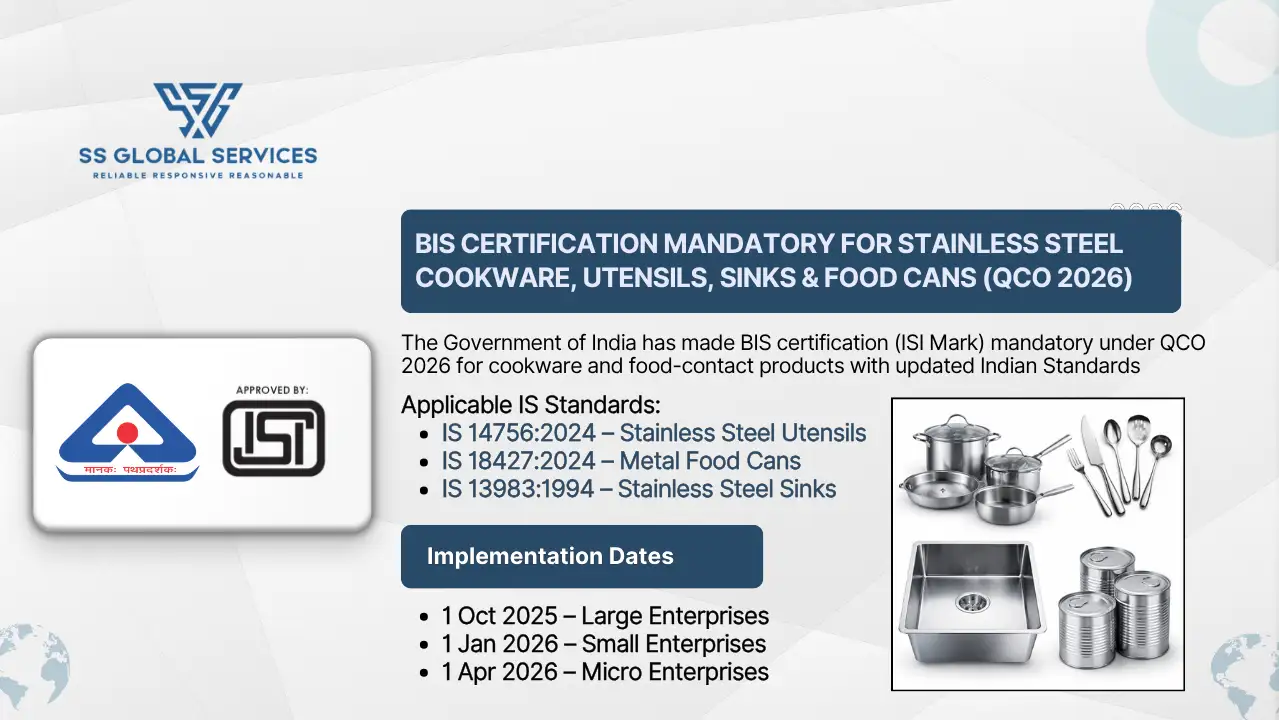
Key Highlights of QCO 2026 Notification
- Issued By: Ministry of Steel
- Order Date: 30 March 2026
- Order Type: Quality Control Order (QCO 2026)
- Replaces: Earlier QCO 2025 (for cookware, utensils & cans)
- Products Covered: Stainless Steel Cookware, Utensils, Sinks & Food Cans
- Standards Covered: IS 14756:2024, IS 18427:2024, IS 13983:1994
- Applicable To: Manufacturers and Importers
- Certification Requirement: Mandatory BIS Certification (ISI Mark)
- Implementation Timeline:
- Large Enterprises : 1 October 2025
- Small Enterprises : 1 January 2026
- Micro Enterprises : 1 April 2026
- Purpose: To ensure product quality, safety, and standard compliance in food-contact products
View Official Notification
- Large Enterprises : 1 October 2025
- Small Enterprises : 1 January 2026
- Micro Enterprises : 1 April 2026
What is Cookware, Utensils and Cans for Foods and Beverages Quality Control Order, 2026
The Cookware, Utensils and Cans for Foods and Beverages (Quality Control) Order, 2026 is a regulation issued by the Ministry of Steel under the BIS Act, 2016. It makes BIS certification mandatory for specified stainless steel and food-contact products to ensure they meet defined quality and safety standards.
This order replaces the earlier QCO 2025 and aligns products with the latest Indian Standards (IS 14756:2024, IS 18427:2024, and IS 13983:1994). It is applicable to both manufacturers and importers, meaning products must be certified before they can be sold or distributed in India.
For businesses, this update is important because it introduces strict compliance requirements, defined implementation timelines, and mandatory certification. Early preparation is essential to avoid delays, penalties, or disruptions in business operations.
Why QCO 2026 is Important for Manufacturers & Importers
- Mandatory BIS certification (ISI Mark) before sale or import
- Compliance with latest IS standards (2024 updates)
- Avoid penalties, product rejection, or legal issues
- Ensures product quality and builds market trust
Products Covered Under QCO 2026 (Cookware, Utensils, Sinks & Cans)
The QCO 2026 applies to specific categories of stainless steel and food-contact products that are widely used in daily life. These products must comply with BIS standards and obtain certification before being manufactured, sold, or imported in India.
Stainless Steel Cookware and Utensils
Under this update, one of the major covered categories is stainless steel utensils, which also includes many commonly used stainless steel cookware and kitchen articles. This category is especially important for manufacturers, importers, and sellers dealing in household and kitchen-use stainless steel products.
Common products that may fall under this category include
- Stainless steel plates
- Stainless steel bowls
- Stainless steel glasses and tumblers
- Stainless steel spoons, forks, and serving tools
- Stainless steel kitchen utensils
- Stainless steel cookware items
- Stainless steel serving articles
- Stainless steel household kitchen articles
This product segment is highly relevant for businesses looking for BIS certification for stainless steel cookware and utensils in India.
Stainless Steel Sinks for Domestic Purposes
The notification also covers stainless steel sinks for domestic purposes, making BIS compliance important for businesses involved in manufacturing, importing, or supplying kitchen sink products in India.
Common products that may fall under this category include
- Stainless steel kitchen sinks
- Single bowl stainless steel sinks
- Double bowl stainless steel sinks
- Stainless steel domestic wash sinks
- Stainless steel household utility sinks
This category is particularly relevant for businesses dealing in BIS certification for stainless steel sinks and domestic stainless steel sink products.
Food and Beverage Cans
Another important category covered under this QCO is three-piece round open top metal cans for foods and beverages. These products are widely used in the packaging industry and are relevant for manufacturers and importers involved in food-grade or beverage-grade can packaging solutions.
Common products that may fall under this category include
- Food packaging metal cans
- Beverage cans
- Round open top food cans
- Metal cans for processed food packaging
- Metal cans used for food and beverage storage
This makes the notification important for businesses seeking BIS certification for food cans and beverage cans in India.
Applicable BIS Standards for Cookware & Stainless Steel Products
Under QCO 2026, all covered products must comply with specific Indian Standards (IS codes) defined by BIS. These standards set the requirements for product quality, safety, material composition, and performance.
Mandatory BIS Standards
- IS 14756:2024: Stainless Steel Utensils (includes cookware)
- IS 18427:2024: Metal Food Cans
- IS 13983:1994: Stainless Steel Sinks
It is important to understand that cookware is covered under IS 14756:2024, which applies to stainless steel utensils used for food preparation and handling.
Additionally, the notification clearly states that the latest version of these standards (including amendments) will always apply. This means businesses must stay updated with any future changes to maintain compliance.
Get Service NowQCO 2026 Implementation Dates for Large, Small and Micro Enterprises
The government has introduced a phased implementation timeline under QCO 2026 to provide businesses with sufficient time to comply with BIS certification requirements. The timeline varies based on the size of the enterprise.
Implementation Timeline
Large Enterprises: 1 October 2025.
Validity Period
Small Enterprises: 1 January 2026.
Applicable Under
Micro Enterprises: 1 April 2026.
This phased approach helps MSMEs get additional time for testing, certification, and compliance preparation. However, after the respective deadlines, all covered products must strictly comply with BIS standards and certification requirements.
Businesses are advised to start the certification process early to avoid last-minute delays or disruptions in operations.
BIS Certification Requirement for Cookware & Stainless Steel Products in India
Under QCO 2026, BIS certification has been made mandatory for all specified Stainless Steel Cookware, Utensils, Sinks and Food Cans (QCO 2026). This means that products must meet the prescribed Indian Standards and carry the ISI Mark before they can be manufactured, sold, or imported in India.
Key Requirements:
- Products must comply with relevant IS standards (IS 14756:2024, IS 18427:2024, IS 13983:1994)
- BIS license is required under the applicable certification scheme
- ISI Mark must be affixed on certified products
- Applicable to both manufacturers and importers
Without BIS certification, businesses may face restrictions on sale, import clearance issues, or regulatory action.
This makes it essential for companies to complete the certification process in advance and ensure full compliance with BIS requirements.
Get Service NowExemptions Under QCO 2026 You Should Know
Although QCO 2026 makes BIS certification mandatory for cookware and stainless steel products, the government has provided certain exemptions and transitional provisions to ease the compliance burden during the initial phase. These exemptions are important for manufacturers and importers to manage existing stock and specific use cases without immediate disruption.
Key Exemptions:
- Export Products: Goods manufactured exclusively for export are not covered under this order
- Existing Stock: Products manufactured or imported before the implementation date can be sold for up to 6 months, subject to proper declaration
- Filled Imported Goods: Products already filled with material (solid, liquid, or gas) are exempt from BIS requirements
- R&D Purpose: Up to 200 units per year can be imported for research and development, but cannot be sold commercially
It is important to note that these exemptions are conditional and time-bound. After the allowed period, all applicable products must comply with BIS certification and relevant IS standards.
Businesses should plan their compliance strategy in advance and maintain proper documentation to avoid any regulatory issues.
Contact Our BIS ExpertImpact of QCO 2026 on Manufacturers, Importers and MSMEs
The implementation of QCO 2026 will have a significant impact on businesses dealing in cookware and stainless steel products. Since BIS certification is now mandatory, companies must align their operations with the latest standards and compliance requirements. For manufacturers and importers, this means focusing more on product quality, testing, and certification processes to ensure smooth business operations in the Indian market.
Impact on Key Stakeholders:
Manufacturers
Manufacturers will need to upgrade their products as per latest IS standards, undergo product testing, and obtain BIS certification before selling in the market. Factory inspections and compliance documentation will also be required.
Importers
Importers must ensure that only BIS-certified products are brought into India. Non-compliant shipments may face delays, rejection, or clearance issues at customs.
MSMEs (Micro, Small & Medium Enterprises)
MSMEs are given a phased implementation timeline, allowing them additional time to prepare for compliance. However, they are still required to meet all BIS certification requirements within the given deadlines.
Official Notification For Cookware, Utensils and Cans for Foods and Beverages Quality Control Order, 2026
As per the official notification, the order has been issued under the BIS Act, 2016, making BIS certification mandatory for the specified products.
Conclusion
The introduction of QCO 2026 marks an important step towards improving the quality, safety, and standardization of cookware and stainless steel products in India. With mandatory BIS certification, updated IS standards, and defined implementation timelines, the government aims to ensure that only compliant products are available in the market.
For manufacturers and importers, this update highlights the need for timely compliance, proper planning, and adherence to BIS requirements. While the initial process may require effort in terms of testing and certification, it will ultimately help businesses build trust, credibility, and long-term growth.
Read Also
Frequently Asked Questions (FAQs)
Request Service Today!
Ready to get certified or need expert compliance support? Fill out the form below and our team at SS Global Services will connect with you shortly.
We offer fast, reliable, and hassle-free assistance for all BIS and regulatory certification needs.