Overview: BIS Update on Lithium Cells and Batteries
The Bureau of Indian Standards (BIS) has issued a new compliance update for portable sealed secondary lithium cells and batteries covered under the BIS Compulsory Registration Scheme (CRS). This update focuses on the verification of rated capacity, which is an important performance parameter for lithium battery products.
The new guideline is relevant for manufacturers, importers, and applicants seeking BIS certification for lithium cells and batteries under IS 16046 (Part 2): 2018 / IEC 62133-2:2017. It has been introduced in line with directions issued by MeitY to improve accuracy in product declarations and strengthen compliance requirements under BIS CRS.
In simple terms, this update means that the declared rated capacity of lithium cells and batteries will now need to be supported through the prescribed verification and reporting process.
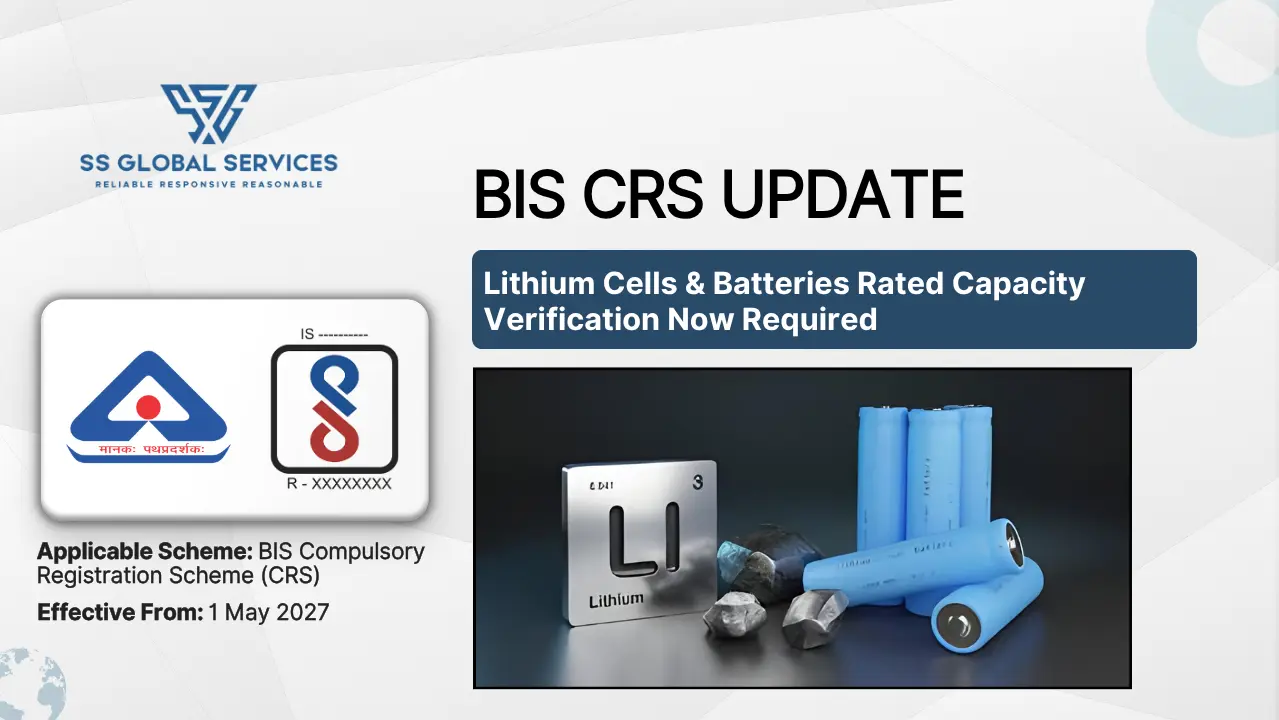
Key Highlights of the Lithium Cells and Batteries Update
- Issued by: Bureau of Indian Standards (BIS)
- Directed by: Ministry of Electronics and Information Technology (MeitY)
- Applicable Scheme: BIS CRS (Compulsory Registration Scheme)
- Reference Update: Guidelines for Verification of Rated Capacity of Lithium Cells & Batteries
- Applicable Product Category: Portable Sealed Secondary Lithium Cells and Batteries
- Applicable Standard: IS 16046 (Part 2): 2018 / IEC 62133-2:2017
- Additional Verification Standard: Clause 7.3.1 of IS 16047 (Part 3): 2018 / IEC 61960-3:2017
- Requirement Introduced: Rated Capacity Verification
- Effective From: 1 May 2027
- Applies To: New Registrations, Renewals, Inclusion / Scope Changes
- Objective: To verify the declared rated capacity and improve product compliance
View Official Notification
Why This Update Has Been Introduced
The new BIS update for lithium cells and batteries has been introduced because the government observed complaints and instances of misdeclaration of rated capacity in the market. In simple words, the battery capacity being claimed on some products may not always have matched the actual tested performance
Since rated capacity is one of the most important technical specifications for lithium battery products, this issue directly affects both consumer trust and product compliance. To address this, MeitY directed that the rated capacity of portable sealed secondary lithium cells and batteries should be properly measured and verified under the applicable BIS framework.
This update has mainly been introduced to:
- improve the accuracy of battery capacity claims
- strengthen BIS CRS compliance for lithium cells and batteries
- reduce chances of incorrect product declarations
- enhance consumer protection and market transparency
This is why BIS has now issued guidelines for rated capacity verification for lithium cells and batteries under IS 16046 (Part 2): 2018 / IEC 62133-2:2017, making the compliance process more performance-focused and technically reliable.
What Exactly Has Changed?
Under this latest BIS update, the key compliance change is that rated capacity for covered lithium cells and batteries must now be formally verified, rather than being treated only as a declared specification.
Previously, products covered under BIS CRS for lithium cells and batteries were already required to comply with the applicable safety requirements under IS 16046 (Part 2): 2018 / IEC 62133-2:2017. However, with the introduction of this new guideline, BIS has now clarified that the declared rated capacity must also be measured and reported through the prescribed verification method.
In practical terms, this update introduces the following compliance change:
- Rated capacity must now be verified through testing
- The verified result must be included as part of the applicable compliance process
- Manufacturers and applicants must ensure that declared battery capacity aligns with actual tested performance
- This requirement will now form part of BIS certification for lithium cells and batteries under the applicable framework
This marks an important shift in the compliance approach for portable sealed secondary lithium cells and batteries, as it strengthens the focus on performance accuracy in addition to existing safety requirements.
In short, this is not a new BIS product inclusion, but a significant compliance enhancement for products already regulated under the BIS Compulsory Registration Scheme (CRS).
Get Service NowApplicable Products and Standards
This BIS CRS update applies specifically to portable sealed secondary lithium cells and batteries covered under the existing BIS registration framework. The guideline is relevant for manufacturers, importers, and applicants dealing with products that fall within the scope of the prescribed Indian Standard for this category.
Applicable Products
The update covers:
- Portable sealed secondary lithium cells
- Portable sealed secondary lithium batteries
Applicable Product Standard
These products are regulated under:
- IS 16046 (Part 2): 2018 / IEC 62133-2:2017
This is the applicable standard for BIS certification for lithium cells and batteries under the Compulsory Registration Scheme (CRS).
Additional Verification Reference
For the newly introduced rated capacity verification requirement, BIS has referred to:
- Clause 7.3.1 of IS 16047 (Part 3): 2018 / IEC 61960-3:2017
This clause relates to:
- Discharge performance at 20°C [rated capacity]
In practical terms, this means that products covered under IS 16046 Part 2 BIS certification will now also need to account for the prescribed verification method for rated capacity as part of compliance planning.
Implementation Timeline and Effective Date
One of the most important aspects of this BIS update is the implementation timeline, which gives industry stakeholders sufficient time to align with the new compliance requirement.
Effective Date:
Last Date for Compliance: 1 May 2027
As per the official notification, the requirement for rated capacity verification for lithium cells and batteries will become applicable from 1 May 2027.
Applicability of the Timeline
This requirement will apply to:
- New BIS CRS registrations
- Renewal of existing registrations
- Inclusion or change in scope of licence
Important Note for Businesses
Manufacturers and importers dealing with BIS certification for lithium cells and batteries should start preparing in advance, as compliance with the updated requirement will be necessary for future approvals under IS 16046 (Part 2): 2018 / IEC 62133-2:2017.
In simple terms, while the update is introduced now, the effective date allows a transition period, giving businesses time to review their testing, documentation, and compliance processes.
Impact on Existing BIS CRS License Holders
This update is also applicable to existing BIS CRS licence holders for lithium cells and batteries. BIS has clarified that compliance with the new rated capacity verification requirement will depend on the validity period of the existing licence.
What Existing License Holders Should Note
- If the licence is valid up to 30 April 2027, compliance must be ensured by 30 April 2027
- If the licence is valid beyond 30 April 2027, compliance must be ensured by the last date of licence validity
- Existing licensees will need to submit the required test reports and related compliance documents, as applicable
Important
Non-compliance may lead to:
- Suspension of licence
- Cancellation of the licence
- Deletion of model(s) from the scope of registration
In short, existing businesses holding BIS registration for lithium cells and batteries should review their current licence validity and prepare for compliance well in advance.
Contact Our BIS ExpertImpact on New Applicants and Future Registrations
The new BIS guideline will also directly affect new applicants applying for BIS certification for lithium cells and batteries under CRS. Going forward, applicants will need to ensure that the rated capacity verification requirement is properly addressed as part of their registration process.
What New Applicants Should Know
- Existing applications already under process may be handled under transitional conditions, as applicable
- After 30 April 2027, no licence will be granted without the required rated capacity verification.
- The same requirement will also apply to future inclusion / scope change cases.
Required Actions for Manufacturers and Importers
Manufacturers and importers dealing with BIS certification for lithium cells and batteries should take proactive steps to align with the new rated capacity verification requirement under BIS CRS.
Key Actions to be Taken
- Review existing product specifications and rated capacity declarations
- Ensure testing is conducted as per the prescribed method for rated capacity verification
- Arrange test reports from BIS-recognized laboratories, wherever applicable
- Initiate updates through the relevant BIS process (amendment / essential requirement module)
- Prepare necessary documentation and undertakings for covered models
- Plan compliance in advance for renewals, new registrations, and scope additions
Important Note: Businesses involved in BIS registration for lithium cells and batteries should start preparing early to avoid last-minute delays and ensure smooth compliance with the updated requirements.
Why This BIS Update Matters for Industry
This BIS update is important because it strengthens compliance around one of the most commercially important specifications in battery products – rated capacity. For manufacturers, importers, and brand owners, this means product claims will now come under greater technical scrutiny under BIS CRS for lithium cells and batteries.
By introducing rated capacity verification for lithium cells and batteries, the regulatory focus is moving beyond basic safety compliance toward greater product accuracy, transparency, and reliability.
From an industry perspective, this update helps to:
- improve confidence in declared battery performance
- reduce the risk of misleading product claims
- strengthen technical accountability in the market
- encourage better compliance readiness among manufacturers and importers
In short, this is not just a regulatory update – it is also an important step toward improving the overall quality and credibility of lithium battery compliance in India.
Read the Official BIS Notification for Lithium Cells & Batteries
For reference, the official BIS / MeitY notification related to rated capacity verification for lithium cells and batteries is provided below. Users can review the original document to understand the exact compliance requirements, implementation timeline, and applicability under BIS CRS.
How SS Global Services Supports BIS CRS Compliance
At SS Global Services, we provide end-to-end support for businesses seeking BIS certification for lithium cells and batteries under the Compulsory Registration Scheme (CRS). Our team assists manufacturers, importers, and brand owners in understanding the latest compliance requirements and preparing the necessary documentation for smooth registration and approval.
Our Support Includes:
- Guidance on BIS registration for lithium cells and batteries
- Assistance with applicable standards such as IS 16046 (Part 2): 2018 / IEC 62133-2:2017
- Support for documentation, compliance review, and application handling
- Coordination for testing and related BIS compliance procedures
- Assistance for new registrations, renewals, amendments, and scope additions
With years of experience in regulatory compliance, we help businesses manage BIS requirements more efficiently and stay prepared for important updates such as the new rated capacity verification guideline.
Read Also
Frequently Asked Questions (FAQs)
Request Service Today!
Ready to get certified or need expert compliance support? Fill out the form below and our team at SS Global Services will connect with you shortly.
We offer fast, reliable, and hassle-free assistance for all BIS and regulatory certification needs.