Introduction: BIS IS 9873 (Part 1) Toy Safety
India's toy safety regulations continue to evolve as the Bureau of Indian Standards (BIS) introduces updates to ensure better compliance and smoother transition for manufacturers. In its latest circular, BIS has extended the implementation deadline for the revised IS 9873 (Part 1): 2025 standard related to toy safety.
This update allows the concurrent running of the previous standard IS 9873 (Part 1): 2019 and the revised IS 9873 (Part 1): 2025, providing manufacturers additional time to adapt their products and packaging to the updated safety requirements.
The extension is particularly important for toy manufacturers and BIS license holders operating under the mandatory BIS certification framework for toys in India.
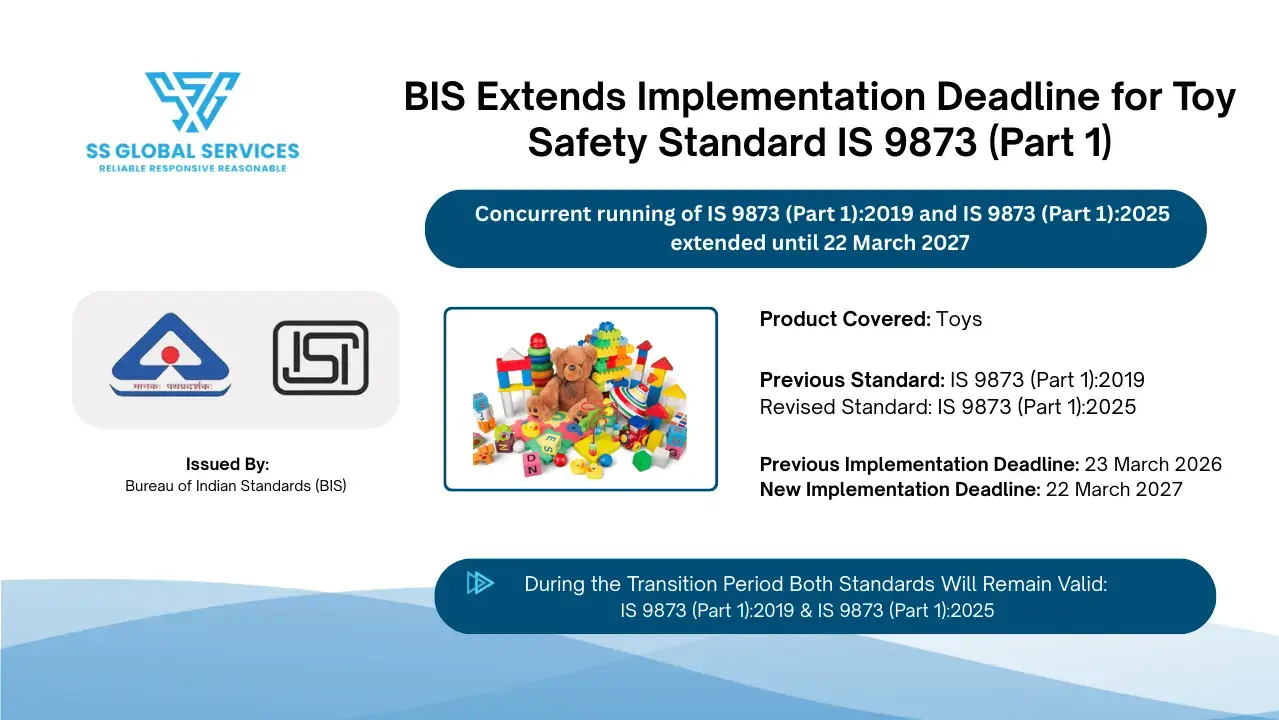
Key Highlights of the BIS Update
-
Issued by: Bureau of Indian Standards (BIS)
-
Department: Central Marks Department-II (CMD-II)
- Notification Date: 30 January 2026
- Product Covered: Toys
- Standard Covered: Safety of Toys - Mechanical and Physical Properties
- Previous Standard: IS 9873 (Part 1): 2019
- Revised Standard: IS 9873 (Part 1): 2025
- Previous Implementation Deadline: 23 March 2026
- New Implementation Deadline: 22 March 2027
- Purpose: Provide additional transition time for implementation of the revised toy safety standard.
View Official Notification
Background of the IS 9873 Toy Safety Standard
The IS 9873 series specifies safety requirements for toys sold in the Indian market. These standards ensure that toys meet essential safety criteria to protect children from potential hazards related to design, materials, and usage.
IS 9873 (Part 1) specifically focuses on mechanical and physical safety aspects of toys, including:
- Structural integrity
- Mechanical hazards
- Physical safety requirements
- Labeling and warning instructions
To keep the standards aligned with modern safety expectations, BIS revised the earlier IS 9873 (Part 1): 2019 standard and introduced the updated IS 9873 (Part 1): 2025 version.
Timeline of the Standard Revision
When the revised IS 9873 (Part 1): 2025 standard was introduced, BIS initially set the implementation deadline as 23 March 2026.
However, considering the practical challenges faced by manufacturers in adopting the revised requirements, BIS has now extended the deadline to 22 March 2027.
This extension allows manufacturers to continue using the existing standard while gradually transitioning to the revised one.
Valid Standards During the Transition Period
As per the latest BIS update, both the previous and revised toy safety standards will remain valid until 22 March 2027.
The standards permitted during the transition period include:
- 9873 (Part 1): 2019
- IS 9873 (Part 1): 2025
This concurrent running period allows manufacturers to align their products with the updated requirements without disrupting ongoing production or supply chains.
Reason for the Implementation Deadline Extension
According to the BIS circular, the revised IS 9873 (Part 1): 2025 standard includes certain modifications that may require manufacturers to update their product packaging and safety warnings.
Some of the key changes involve:
- Updates in the location of warning labels on toy packaging
- Revised requirements for specific toy categories
Because these changes may require adjustments in packaging design, labeling practices, and compliance documentation, BIS has granted additional time for manufacturers to implement the revised standard effectively.
What This Means for Toy Manufacturers
For manufacturers producing toys under the BIS certification scheme, this extension provides an important opportunity to prepare for the revised requirements.
Manufacturers can use this additional time to:
- Review the updated safety requirements under IS 9873 (Part 1): 2025
- Update product labeling and packaging warnings where necessary
- Align product design and testing procedures with the revised standard
- Ensure compliance before the final implementation deadline
Preparing early will help manufacturers avoid compliance disruptions once the revised standard becomes mandatory.
Importance of Toy Safety Standards in India
Toy safety standards play a critical role in protecting children from potential hazards associated with poorly designed or unsafe products. The BIS ISI certification for toys is mandatory in India under the Toys (Quality Control) Order, ensuring that toys sold in the country meet strict safety and quality requirements.
Updates to standards such as IS 9873 (Part 1) help ensure that toy manufacturers adopt improved safety practices while maintaining product reliability and consumer confidence.
Conclusion
The extension of the implementation deadline for IS 9873 (Part 1): 2025 reflects BIS’s effort to support the toy industry during the transition to updated safety standards.
By allowing the concurrent running of IS 9873 (Part 1): 2019 and IS 9873 (Part 1): 2025 until 22 March 2027, BIS ensures that manufacturers have sufficient time to update packaging, safety warnings, and product compliance procedures.
Toy manufacturers and BIS license holders should use this transition period to review the revised standard and begin aligning their products with the updated safety requirements well before the final implementation deadline.
Read the Official BIS Notification on Implementation Deadline for Revised IS 9873 (Part 1) Toy Safety Standard
Frequently Asked Questions (FAQs)
- IS 9873 (Part 1): 2019
- IS 9873 (Part 1): 2025
Request Service Today!
Ready to get certified or need expert compliance support? Fill out the form below and our team at SS Global Services will connect with you shortly.
We offer fast, reliable, and hassle-free assistance for all BIS and regulatory certification needs.