Overview:
The Indian government has expanded the scope of the BIS Compulsory Registration Scheme (CRS) by bringing Extended Reality (XR) devices under mandatory compliance. As a result, products such as Augmented Reality (AR), Virtual Reality (VR), and Mixed Reality (MR) devices can no longer be manufactured, imported, or sold in India without obtaining BIS CRS registration.
With the growing adoption of XR technologies across gaming, education, healthcare, industrial training, and enterprise applications, regulatory oversight has become essential to ensure product safety and reliability. This update formally places XR devices within India’s electronic safety framework, making compliance a legal requirement for all stakeholders involved in their supply and distribution.
The update aligns XR products with India’s evolving electronic safety regulations and introduces a unified safety standard for modern audio-visual and information technology equipment. For manufacturers and importers, this marks a critical compliance milestone that must be addressed within the prescribed timelines to avoid approval delays, import restrictions, or business disruption.
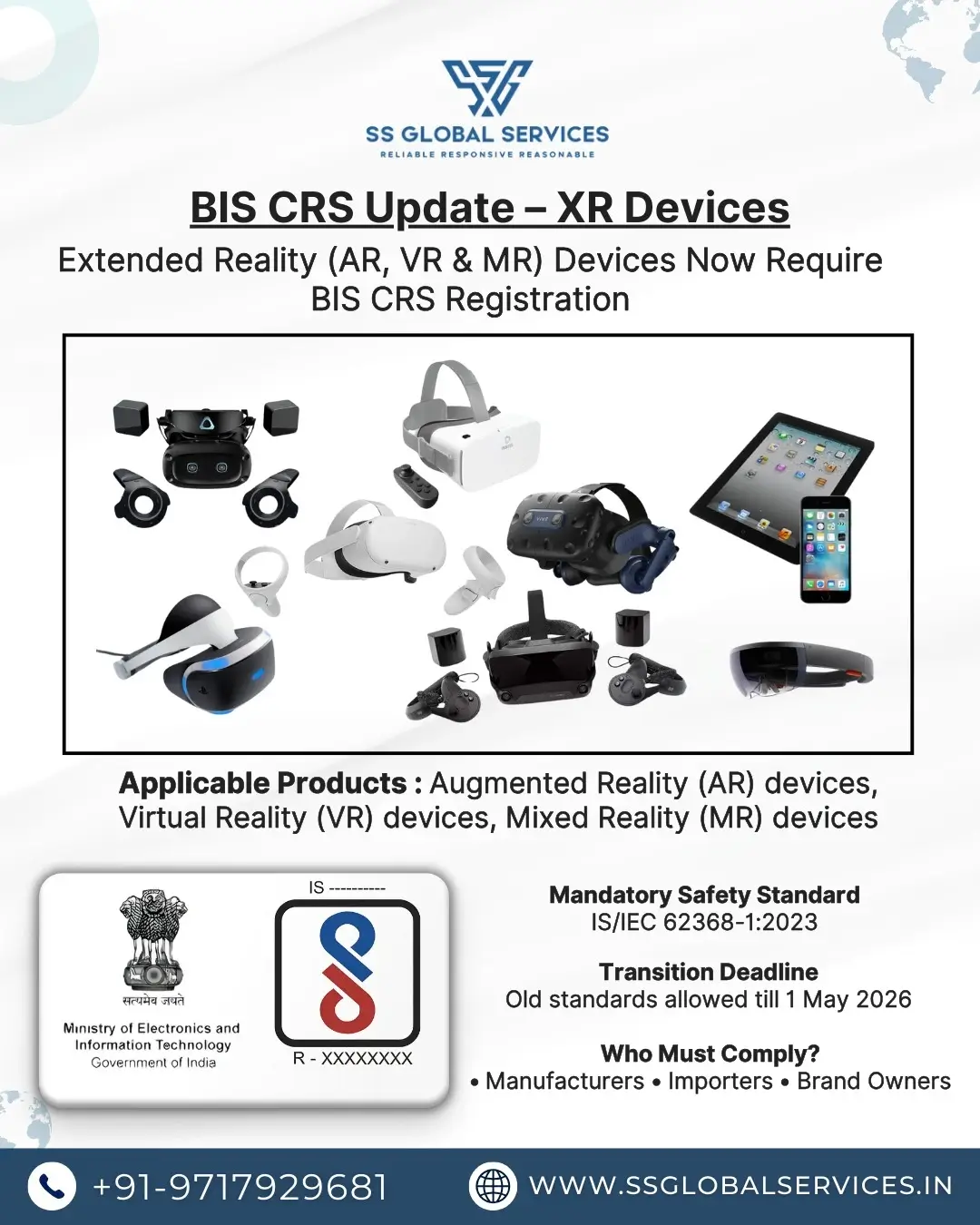
Key Highlights of the BIS CRS Update for XR Devices
- Issued by: Ministry of Electronics and Information Technology (MeitY)
- Implemented by: Bureau of Indian Standards (BIS)
- Notification Date: 29 October 2025
- Applicable Products: Extended Reality (XR) devices – AR, VR & MR
- Scheme: BIS Compulsory Registration Scheme (CRS)
- New Mandatory Standard: IS/IEC 62368-1:2023
- Replaces Standards: IS 13252 (Part 1): 2010 and IS 616: 2017
- CRS Status: XR devices newly notified under CRS
- Testing Requirement: BIS-recognized laboratory testing mandatory
- Transition Period for XR Devices: Valid till 1 May 2026
- Post Deadline: Only IS/IEC 62368-1:2023 accepted
- Compliance Requirement: Mandatory before manufacture, import, or sale in India
What Are Extended Reality (XR) Devices?
Extended Reality (XR) is a collective term used for technologies that blend digital and physical environments. These devices are increasingly used in gaming, education, healthcare, industrial training, and enterprise applications.
-
Augmented Reality (AR) Devices
Augmented Reality devices overlay digital content onto the real world. Common examples include AR smart glasses and headsets that display images, data, or animations while allowing users to see their physical surroundings.
-
Virtual Reality (VR) Devices
Virtual Reality devices create a fully immersive digital environment. VR headsets block out the real world and simulate a computer-generated experience, widely used in gaming, simulations, and professional training.
-
Mixed Reality (MR) Devices
Mixed Reality devices combine elements of both AR and VR. They allow digital objects to interact with the real world in real time, enabling advanced use cases such as industrial design, remote collaboration, and medical visualization.
BIS Notification Bringing XR Devices Under CRS
The Ministry of Electronics and Information Technology (MeitY), through an official notification issued under the Electronics and Information Technology Goods (Requirement of Compulsory Registration) Order, 2021, has formally notified Extended Reality (XR) products under CRS.
With this amendment, XR devices have been added as a distinct product category, making BIS CRS registration mandatory before these products can be placed on the Indian market. The regulation is enforced by the Bureau of Indian Standards, which is the national authority responsible for product safety and conformity assessment.
Applicable Indian Safety Standard for XR Devices
New Mandatory Standard: IS/IEC 62368-1:2023
All AR, VR, and MR devices notified under CRS must now comply with IS/IEC 62368-1:2023, titled Audio/Video, Information and Communication Technology Equipment – Safety Requirements.
This standard is internationally harmonized and focuses on hazard-based safety engineering. It addresses risks related to electrical energy, fire, mechanical hazards, radiation, and thermal effects, making it suitable for modern, high-technology electronic products such as XR devices.
Standards Replaced Under This Update
With the adoption of IS/IEC 62368-1:2023, the following older standards are being phased out:
- IS 13252 (Part 1): 2010 – Information Technology Equipment
- IS 616: 2017 – Audio, Video and Similar Electronic Apparatus
Note: The shift ensures a single, unified safety framework instead of multiple legacy standards.
Transition & Concurrent Validity Period
To allow businesses sufficient time to adapt, the government has provided a transition period during which old and new standards may run concurrently.
Timeline for XR (AR, VR & MR) Devices
For Extended Reality products, concurrent validity of old standards with IS/IEC 62368-1:2023 is permitted until 1 May 2026. After this date, compliance with the new standard becomes mandatory.
Timeline for Other CRS Products
For other CRS-covered products migrating to IS/IEC 62368-1:2023, concurrent validity is allowed until 1 November 2028.
What Happens After the Deadline
Once the applicable deadlines expire, IS 13252:2010 and IS 616:2017 will be withdrawn, and products tested under these standards will no longer be accepted for CRS registration or renewal.
Who Needs to Comply With This Update?
This update applies to all stakeholders involved in the XR product supply chain, including:
- Indian manufacturers of AR, VR, and MR devices
- Foreign manufacturers exporting XR products to India
- Importers and brand owners selling XR devices in India
- OEM and ODM manufacturers supplying XR hardware
Any entity placing XR devices on the Indian market must ensure BIS CRS compliance.
Impact of This Update on Manufacturers & Importers
The inclusion of Extended Reality (AR, VR & MR) devices under the BIS Compulsory Registration Scheme brings clear compliance responsibilities for manufacturers and importers. This update directly affects product testing, certification planning, and market entry timelines for XR devices in India.
-
Mandatory Testing as per IS/IEC 62368-1:2023
All XR devices are required to undergo safety testing as per IS/IEC 62368-1:2023 at BIS-recognized testing laboratories.
-
Review of Existing Product Designs
Manufacturers may need to assess current XR product designs and make necessary safety-related modifications to meet the new standard.
-
Fresh Testing for New Registrations or Model Additions
New BIS CRS registrations and additional product models may require fresh test reports based on the updated safety standard.
-
Risk of Customs Rejection or Market Withdrawal
Non-compliant XR devices may face import clearance issues, sales restrictions, or removal from the Indian market.
-
Importance of Early Compliance Planning
Timely compliance planning helps manufacturers and importers avoid approval delays, shipment disruptions, and financial losses.
BIS CRS Registration Process for XR Devices
The CRS registration process for XR devices generally involves:
- Product testing at a BIS-recognized laboratory as per IS/IEC 62368-1:2023
- Preparation of technical documentation, including test reports and product details
- Online application submission under the CRS portal
- Evaluation by BIS and grant of CRS registration
- Use of CRS marking on the product and packaging
Once approved, the registration allows legal sale and distribution in India.
Penalties for Non-Compliance
Failure to comply with BIS CRS requirements can lead to:
- Prohibition on manufacturing or importing XR devices
- Seizure of non-compliant products
- Monetary penalties under the BIS Act
- Damage to brand reputation and business continuity
Compliance is not optional and must be ensured before market entry.
How SS Global Services Can Help
Navigating BIS CRS compliance for Extended Reality (AR, VR & MR) devices can be complex due to evolving safety standards and strict regulatory timelines. At SS Global Services, we provide end-to-end BIS CRS registration support to help manufacturers and importers achieve smooth and timely compliance.
With over 13+ years of experience in certification and regulatory approvals, our expert team ensures that XR products meet all BIS requirements under IS/IEC 62368-1:2023 without unnecessary delays or rejections.
-
Compliance assessment for AR, VR, and MR products
We evaluate product scope and safety requirements to ensure readiness for BIS CRS registration.
-
Coordination with BIS-recognized testing laboratories
Our team manages testing coordination to ensure accurate and compliant test reports.
-
Documentation preparation and application filing
We handle technical documentation and CRS application filing to minimize errors and rework.
-
Support for Indian and foreign manufacturers
We assist both domestic and overseas manufacturers with complete BIS CRS compliance support.
-
Timely guidance to meet transition deadlines
Our experts help businesses plan compliance within prescribed timelines to avoid disruptions.
Our experience helps businesses achieve smooth, error-free compliance with minimal delays, enabling uninterrupted manufacturing, import, and sale of XR devices in the Indian market.
Conclusion
The inclusion of Extended Reality (AR, VR & MR) devices under BIS CRS is a significant regulatory development for the electronics industry in India. Manufacturers and importers must act proactively to ensure compliance with IS/IEC 62368-1:2023 within the prescribed timelines.
Early preparation, correct testing, and expert guidance can help businesses avoid regulatory hurdles and ensure uninterrupted market access. If you deal in XR products, now is the right time to initiate your BIS CRS compliance process.
Read the Official BIS Notification on Extended Reality (XR) Devices Under CRS
This is the official notification issued by the Ministry of Electronics and Information Technology (MeitY) regarding the inclusion of Extended Reality (AR, VR & MR) devices under the BIS Compulsory Registration Scheme (CRS). The notification outlines the adoption of IS/IEC 62368-1:2023 as the mandatory safety standard, the transition and concurrent validity timelines, and the withdrawal of older standards. Manufacturers and importers are advised to carefully review the notification to ensure timely and complete compliance before manufacturing, importing, or selling XR devices in India.
Frequently Asked Questions (FAQs)
BIS CRS registration for Extended Reality (AR, VR & MR) devices often raises important compliance-related questions for manufacturers, importers, and brand owners. Below are the most commonly asked questions to help you understand the regulatory requirements, applicable standards, and compliance timelines in India.
Request Service Today!
Ready to get certified or need expert compliance support? Fill out the form below and our team at SS Global Services will connect with you shortly.
We offer fast, reliable, and hassle-free assistance for all BIS and regulatory certification needs.