INTRODUCTION
The MTCTE Update 2026 has introduced a significant change in the certification process for 5G Core Nodes in India, especially for products that are completely software-based or virtualized. Issued by the Telecommunication Engineering Centre (TEC) under the Department of Telecommunications (DoT), this update aims to simplify compliance while maintaining essential technical standards.
With the new update, effective from 1 July 2026, TEC has adopted a more practical approach. Instead of mandatory testing for every requirement, the process now allows partial testing for critical network functions, while the remaining parameters can be fulfilled through a Self-Declaration of Conformity (Annexure-I).
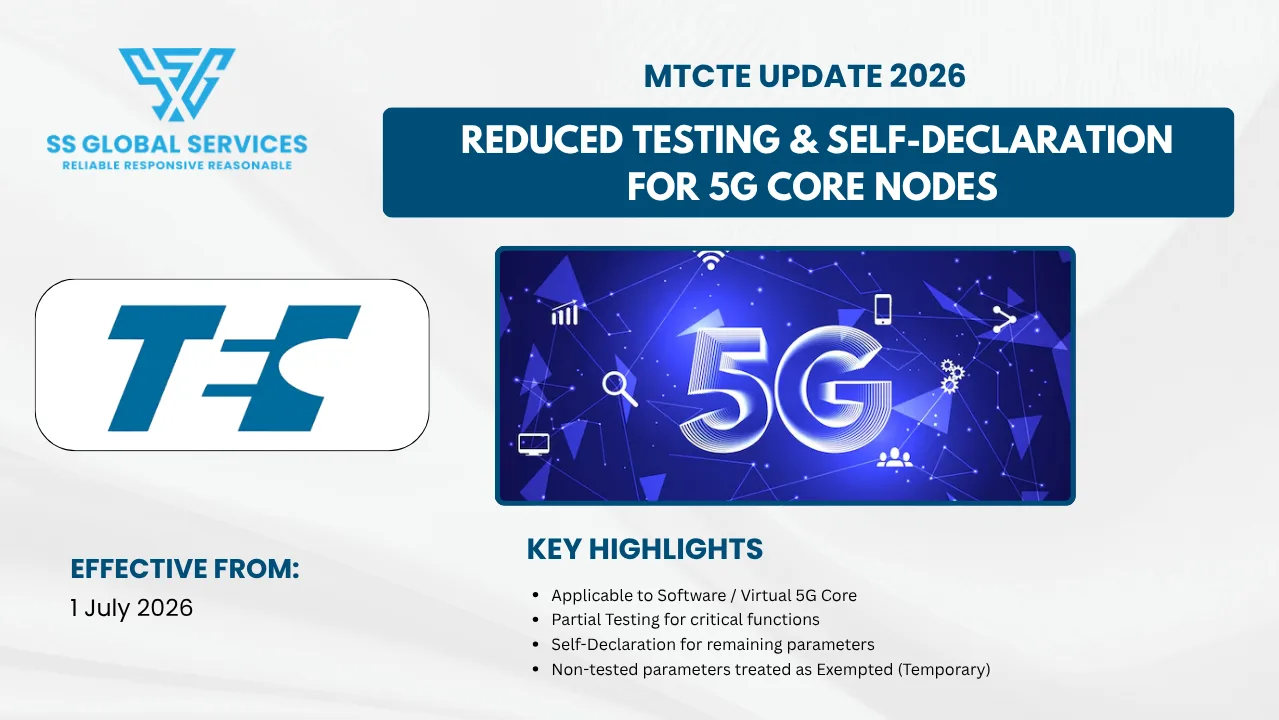
Key Highlights of MTCTE 5G Core Update 2026
- Issued By: TEC, DoT (Government of India)
- Issue Date: 16 April 2026
- Subject: Certification update for Virtual / Software-Based 5G Core Nodes
- Applicable To: Virtualized / Software 5G Core (AMF, SMF, UPF, PCF, AuSF)
- Testing: Partial testing for critical parameters only
- Self-Declaration: Allowed for remaining parameters (Annexure-I)
- Exempted: Non-tested parameters treated as temporary exempted
- BoM Requirement: Must mention "Virtualized / Software-Based Product"
- Effective Date: 1 July 2026
What is MTCTE Certification for 5G Core?
MTCTE (Mandatory Testing and Certification of Telecom Equipment) is a regulatory framework introduced by the Department of Telecommunications (DoT), Government of India, and implemented by the Telecommunication Engineering Centre (TEC).
It ensures that telecom products are tested and certified before being sold or deployed in India, maintaining standards for safety, performance, and network reliability.
In the case of 5G Core, MTCTE certification applies to the critical network functions that form the backbone of a 5G network.
- AMF (Access & Mobility Management Function) – Handles user mobility and access control
- SMF (Session Management Function) – Manages data sessions
- UPF (User Plane Function) – Handles data traffic flow
- PCF (Policy Control Function) – Controls policies and QoS
- AuSF (Authentication Server Function) – Ensures user authentication
These components are essential for ensuring that a 5G network operates securely and efficiently.
Talk With BIS ExpertTesting Requirements for 5G Core Nodes under MTCTE
Under the MTCTE framework, telecom products are required to undergo testing in TEC-designated laboratories (CABs) to ensure compliance with defined Essential Requirements (ER). For 5G Core Nodes, this includes validation of critical network functions that directly impact performance, security, and interoperability.
With the MTCTE 2026 update, the testing approach has been revised. Instead of testing all parameters, only selected critical functions now require mandatory testing, especially for virtualized and software-based 5G Core systems.
This change reduces unnecessary testing while ensuring that core network operations remain reliable and secure.
Key Testing Areas:
- AMF (Access & Mobility Management Function) – Registration, mobility handling, session control
- SMF (Session Management Function) – PDU session establishment, activation, and release
- UPF (User Plane Function) – Data forwarding and N4 interface procedures
- PCF (Policy Control Function) – Policy creation and control mechanisms
- AuSF (Authentication Server Function) – User authentication and security protocols
These functions are considered critical for 5G network performance, which is why they still require testing through approved labs.
Self-Declaration in MTCTE 2026 (Annexure-I Explained)
One of the most important changes introduced in the MTCTE 2026 update is the allowance of Self-Declaration of Conformity for parameters that are not required to be tested.
Instead of undergoing lab testing for every requirement, applicants can now submit a formal declaration confirming that their product complies with the applicable Essential Requirements (ER). This declaration must be submitted in the prescribed Annexure-I format on the MTCTE portal.
This approach is specifically beneficial for virtualized and software-based 5G Core nodes, where full-scale testing is not always necessary.
| SI. No. | Variant of 5G Core | Parameter Name |
|---|---|---|
| 1. | AMF | AN Release-AMF |
| Initial Registration and Deregistration-AMF | ||
| Mobility Management-Location Report-AMF | ||
| PDU Session Establishment and Deletion-AMF | ||
| Service Request-AMF | ||
| SMF selection-AMF | ||
| 2. | AuSF | NRF Communication-AuSF |
| Support for 5G AKA-AuSF | ||
| Support for UE Authentication-AuSF | ||
| 3. | PCF | NRF Communication-PCF |
| Support for SM Policy control create-PCF | ||
| 4. | SMF | N4 Association for Node and Session-SMF |
| PDU Session Activation and Deactivation-SMF | ||
| PDU Session Establishment-SMF | ||
| PDU Session Release-SMF | ||
| Registration with NRF Update and Discovery-SMF | ||
| Support configuration of QFI 5QI ARP-SMF | ||
| 5. | UPF | N4 Procedures – UPF |
Exempted Parameters under MTCTE
Under the MTCTE 2026 update, not all parameters require mandatory testing. The parameters that are not covered under the testing list are currently treated as "Exempted", provided they are supported with a valid Self-Declaration of Conformity (Annexure-I).
This means that while these parameters are not tested in labs, they are still considered part of the compliance framework and must meet the required standards.
What are Exempted Parameters?
- Not included in the mandatory testing scope
- Allowed to be declared through self-declaration
- Temporarily relaxed until further notification by TEC
- Still require compliance with Essential Requirements (ER)
Key Points to Understand:
- These parameters are not permanently removed from compliance
- They are temporarily exempted to simplify certification
- Future updates may reintroduce testing requirements
- Self-declaration is mandatory for these parameters
Important Compliance Requirement (BoM Declaration)
In addition to the revised testing and self-declaration approach, the MTCTE 2026 update also introduces an important documentation requirement related to the Bill of Materials (BoM). Applicants are required to clearly specify in the BoM that the product is a "Completely Virtualized / Software-Based Product."
This declaration plays a crucial role in the certification process, as it helps the Telecommunication Engineering Centre (TEC) correctly identify the nature of the product. Based on this classification, the product becomes eligible for the revised compliance framework, including partial testing and self-declaration.
It is important to note that this information must be mentioned specifically in the Remarks column of the BoM at the time of application submission. Even though it appears to be a simple requirement, missing or incorrect declaration can lead to unnecessary delays, queries, or even rejection of the application.
Key Points to Remember:
- BoM Declaration: Must mention "Virtualized / Software-Based Product" in BoM
- Remarks Requirement: Required in the Remarks column during submission
- Applicability: Applicable for all 5G Core virtualized solutions
- Impact: Impacts eligibility for reduced testing & self-declaration
- Risk: Incorrect or missing details may lead to delays or rejection
Ensuring accurate and clear BoM documentation is essential for smooth processing of MTCTE certification for 5G Core Nodes, especially in the case of modern software-driven telecom systems.
Get Service NowBenefits of the MTCTE 2026 Update
The MTCTE 2026 update for 5G Core Nodes introduces a more practical and flexible certification approach, especially for software-based and virtualized telecom systems. By shifting from full testing to a partial testing and self-declaration model, this update significantly improves the overall compliance process.
For companies working in the 5G ecosystem, this change not only reduces operational challenges but also enables faster deployment of advanced telecom solutions.
- Reduced Testing Cost: Only critical parameters require lab testing, helping companies avoid unnecessary expenses.
- Faster Certification Process: With fewer parameters to test, approval timelines are significantly reduced.
- Simplified Compliance: Self-declaration for non-critical parameters makes the process more manageable.
- Better Alignment with Modern Technology: Supports cloud-based, virtualized, and software-driven 5G Core architectures.
- Encourages Innovation: Reduces regulatory barriers, allowing faster rollout of new telecom solutions.
Official Notification For MTCTE Update 2026
Conclusion
The MTCTE 2026 update for 5G Core Nodes marks a significant shift in the way telecom products are certified in India. By introducing a partial testing approach along with self-declaration, the framework becomes more aligned with the realities of modern software-based and virtualized 5G networks.
This update not only reduces the overall compliance burden but also enables faster certification, lower costs, and quicker deployment of 5G Core solutions. At the same time, it places greater responsibility on applicants to ensure that they correctly identify which parameters require testing and which can be self-declared.
Read Also
Frequently Asked Questions (FAQs)
Request Service Today!
Ready to get certified or need expert compliance support? Fill out the form below and our team at SS Global Services will connect with you shortly.
We offer fast, reliable, and hassle-free assistance for all BIS and regulatory certification needs.