- Overview
- What is CDSCO License?
- Types of CDSCO License
- Why Is a CDSCO License Required for Your Business?
- CDSCO Certification Process
- Documents Required for CDSCO Registration
- Why is CDSCO Registration Mandatory?
- Who Needs CDSCO Registration?
- Time Required for CDSCO Certification
- What Happens After CDSCO Approval?
- Why Choose SS Global Services for CDSCO License?
- Frequently Asked Questions (FAQs)
Overview:
The Central Drugs Standard Control Organisation (CDSCO) is India’s national regulatory authority for drugs and plays a central role in regulating medical devices and cosmetics under the applicable laws and regulatory frameworks. Businesses involved in the manufacturing, import, distribution or marketing of drugs, cosmetics and medical devices in India may be required to obtain the applicable CDSCO registration, license, approval or other regulatory permission before placing their products on the Indian market.
CDSCO License and Registration requirements vary according to the type of product, its intended use, risk classification, and the nature of the business activity. Medical devices, cosmetics and drugs are governed through different regulatory frameworks and may require different applications, technical documents, licences, registrations or approvals. Therefore, identifying the correct regulatory pathway is an important step for businesses planning to manufacture or import these products in India.
For medical devices, the applicable requirements depend on factors such as the device classification and whether the product is being manufactured or imported. Cosmetic products are subject to specific registration or licensing requirements depending on whether they are imported or manufactured in India. Drugs and pharmaceutical products may require registration, import licensing or other approvals depending on the product and proposed activity.
Understanding the CDSCO registration and licensing process, applicable documentation and regulatory requirements can help businesses prepare their applications correctly and avoid unnecessary delays during the approval process.
At SS Global Services, we provide regulatory compliance support for CDSCO License & Registration for Medical Devices, Cosmetics & Drugs, assisting businesses with regulatory assessment, documentation, application preparation, submission and coordination throughout the applicable approval process.
What is CDSCO License?
A CDSCO License is a regulatory authorization required for certain drugs, medical devices, cosmetics and other regulated products before they can be manufactured, imported, or marketed in India, depending on the applicable regulations and business activity. The Central Drugs Standard Control Organisation (CDSCO) performs central regulatory functions, while certain licensing responsibilities are handled by the respective State Licensing Authorities.
The requirement for a CDSCO license is not the same for every product. It depends on factors such as the type of product, intended use, risk classification, manufacturing or import activity, and applicable regulatory framework. For example, medical devices are regulated according to their risk classification, while drugs and cosmetics follow their respective regulatory requirements.
Obtaining the appropriate license allows an eligible business to carry out the permitted manufacturing or import activity in accordance with the applicable regulations. Depending on the product and regulatory pathway, the process may also involve registration, approval, or other regulatory permissions from the competent authority.
Types of CDSCO License
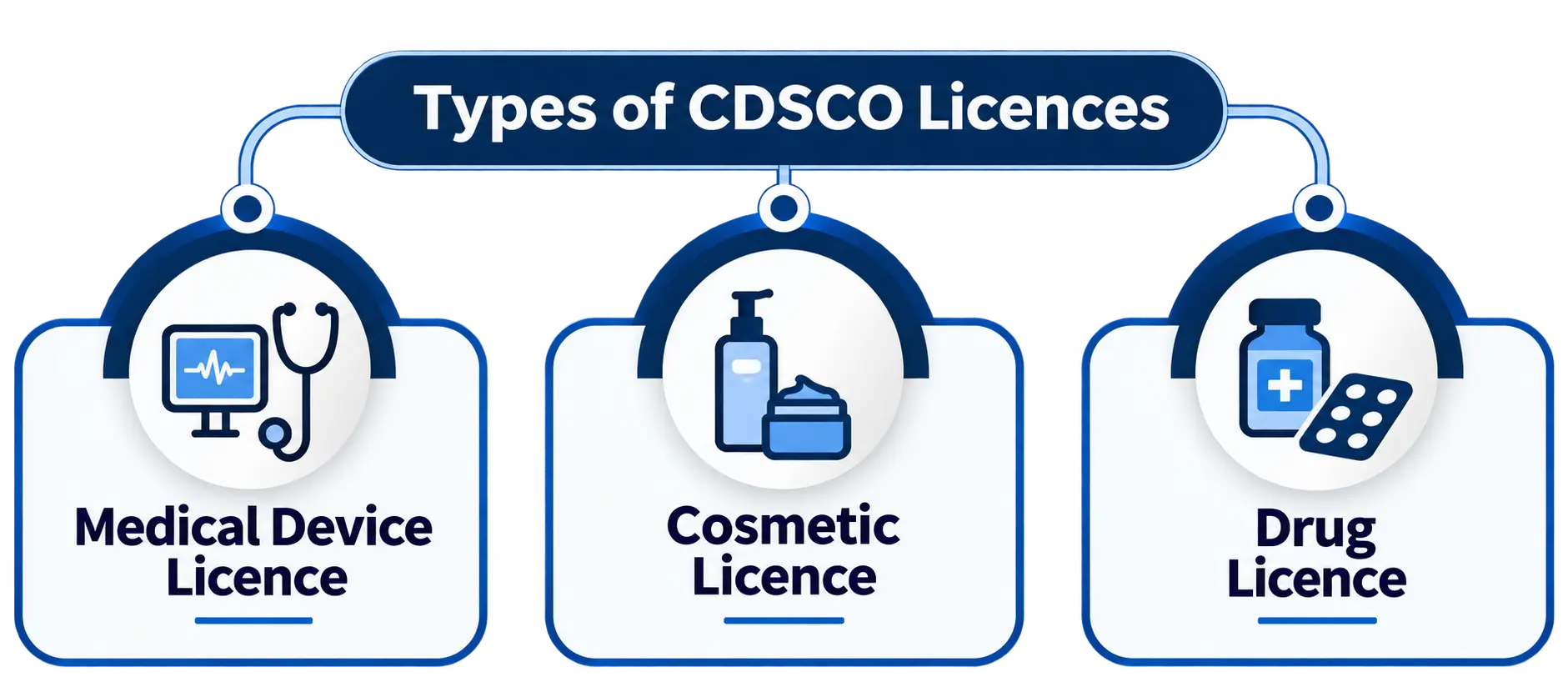
CDSCO licensing is broadly divided into three major categories: Medical Device License, Drug License, and Cosmetic License. The applicable requirements, licensing authority, and regulatory process differ for each category. Identifying the correct product category and applicable license before starting the application is important to ensure that the product follows the right regulatory pathway.
1. Medical Device License
Medical devices in India are regulated under the Medical Devices Rules, 2017. Before a medical device can be manufactured or imported for sale in India, the applicable regulatory requirement must be identified based on the risk classification and intended use of the device.
- Class A – Low risk (e.g., thermometers, tongue depressors)
- Class B – Low-moderate risk (e.g., syringes, BP monitors)
- Class C – Moderate-high risk (e.g., ventilators, dialysis equipment)
- Class D – High risk (e.g., heart valves, implants)
CDSCO License for Medical Device Manufacturers
Companies manufacturing medical devices in India must obtain the applicable manufacturing license based on the classification of their device. For Class A and Class B devices, the application is submitted in Form MD-3, and the manufacturing license is issued in Form MD-5. For Class C and Class D devices, the application is submitted in Form MD-7, and the manufacturing license is issued in Form MD-9.
Class B devices are generally licensed by the State Licensing Authority, while Class C and Class D devices are licensed by the Central Licensing Authority (CDSCO). Class A devices have specific provisions; Class A non-sterile and non-measuring devices are exempt from the regular licensing requirement and are subject to registration under the applicable provisions.
CDSCO Import License for Medical Devices
Businesses importing medical devices into India are required to follow the applicable CDSCO import requirements. The Medical Device Import License is issued by the Central Licensing Authority, and the application is made in Form MD-14, with the license issued in Form MD-15.
The import requirements apply according to the applicable regulatory provisions and device category. Therefore, importers should first establish the correct classification and regulatory status of the device before applying for the CDSCO import approval.
2. Cosmetic License
Cosmetic products sold in India must comply with the applicable requirements under the Cosmetics Rules, 2020. These rules cover cosmetics manufactured within India as well as products imported from other countries for commercial sale. The regulatory route depends on the nature of the product and whether the business is involved in manufacturing or importing.
Businesses planning to launch a cosmetic brand in India should identify the applicable licensing or registration requirements before beginning commercial operations. The requirements may differ for domestic manufacturers, importers, and businesses introducing an international cosmetic brand into the Indian market.
CDSCO Cosmetic License for Manufacturers
Businesses manufacturing cosmetics in India must obtain the applicable Cosmetic Manufacturing License from the respective State Licensing Authority. The application for a manufacturing license is submitted in Form COS-5, and the license is issued in Form COS-8.
For businesses manufacturing cosmetics under a loan license arrangement, the application is submitted in Form COS-6, and the loan license is issued in Form COS-9. Manufacturers must also comply with relevant requirements for manufacturing premises, facilities, product quality, ingredients, labelling, and packaging.
CDSCO Cosmetic Registration for Importers
Businesses importing cosmetics into India must obtain the applicable CDSCO Cosmetic Registration before import. The application is submitted in Form COS-1, and the Import Registration Certificate is issued in Form COS-2.
The registration covers relevant product details, manufacturing premises, pack sizes, and applicable variants. Importers must ensure that their products are covered by the registration and meet the applicable Indian regulatory requirements before placing them on the market.
3. Drug License
Drug licensing in India covers products such as allopathic medicines, vaccines, biological products, and new drugs. The applicable requirements depend on the type of drug and the business activity, including manufacturing, importing, selling, or distributing. Depending on the product, businesses may require a Drug Manufacturing License, CDSCO registration, an Import License, or separate regulatory approval
CDSCO Drug License for Manufacturers
Companies manufacturing drugs in India must obtain the applicable Drug Manufacturing License from the concerned State Licensing Authority. The requirements depend on the drug category and manufacturing activity, including compliance with applicable standards for manufacturing facilities, quality control, and good manufacturing practices.
Certain drugs, particularly products classified as new drugs, may also require CDSCO approval before manufacture or marketing, as applicable. Manufacturers should identify the relevant licensing and approval requirements for their products before commencing operations.
CDSCO Drug License for Importers
Businesses importing drugs into India must comply with the applicable CDSCO drug registration and import licensing requirements. Depending on the product, this may involve obtaining a Registration Certificate for the drug and its manufacturing site, followed by the applicable Import License. The required forms and approvals vary according to the drug category and relevant regulations.
Importers must ensure that the necessary regulatory permissions are in place before importing drugs for commercial sale or distribution. The applicable route should be confirmed based on the product's regulatory status and intended use.
New Drug Approval & Clinical Trial Permission
New drugs and investigational products may require specific permissions under the New Drugs and Clinical Trials Rules, 2019. CDSCO approval may be necessary for clinical trials and for the import or manufacture of new drugs, depending on the proposed activity and the product's regulatory status.
The approval requirements may include information about product quality, safety, efficacy, and clinical study data. Businesses developing or introducing a new drug in India should identify the applicable regulatory pathway before starting clinical trials or commercial activities.
Why Is a CDSCO License Required for Your Business?
Obtaining the applicable CDSCO License, Registration, or Approval is an important regulatory requirement for businesses dealing with medicines, medical devices, and cosmetics in India. It helps businesses meet the applicable legal requirements and establish a compliant route for placing regulated products in the Indian market.
-
Legal Market Access:
The required license or registration must be in place before carrying out regulated activities such as manufacturing or importing, as applicable to the product.
-
Product Safety & Quality:
CDSCO and the relevant licensing authorities regulate products to ensure that applicable safety, quality, and performance requirements are followed.
-
Import & Customs Compliance:
Businesses importing regulated products need the applicable CDSCO documentation and approvals to meet regulatory requirements during the import process.
-
Business Credibility:
A valid regulatory license or registration helps businesses demonstrate compliance when working with distributors, hospitals, retailers, institutional buyers, and other business partners.
-
Avoid Regulatory Issues:
Operating without the required approval can result in regulatory action, including restrictions on manufacturing, import, sale, or distribution, depending on the nature of the non-compliance.
-
Market Expansion:
Proper regulatory compliance can also support businesses when entering new markets, working with international partners, or obtaining regulatory documents required for export-related activities.
CDSCO Certification Process
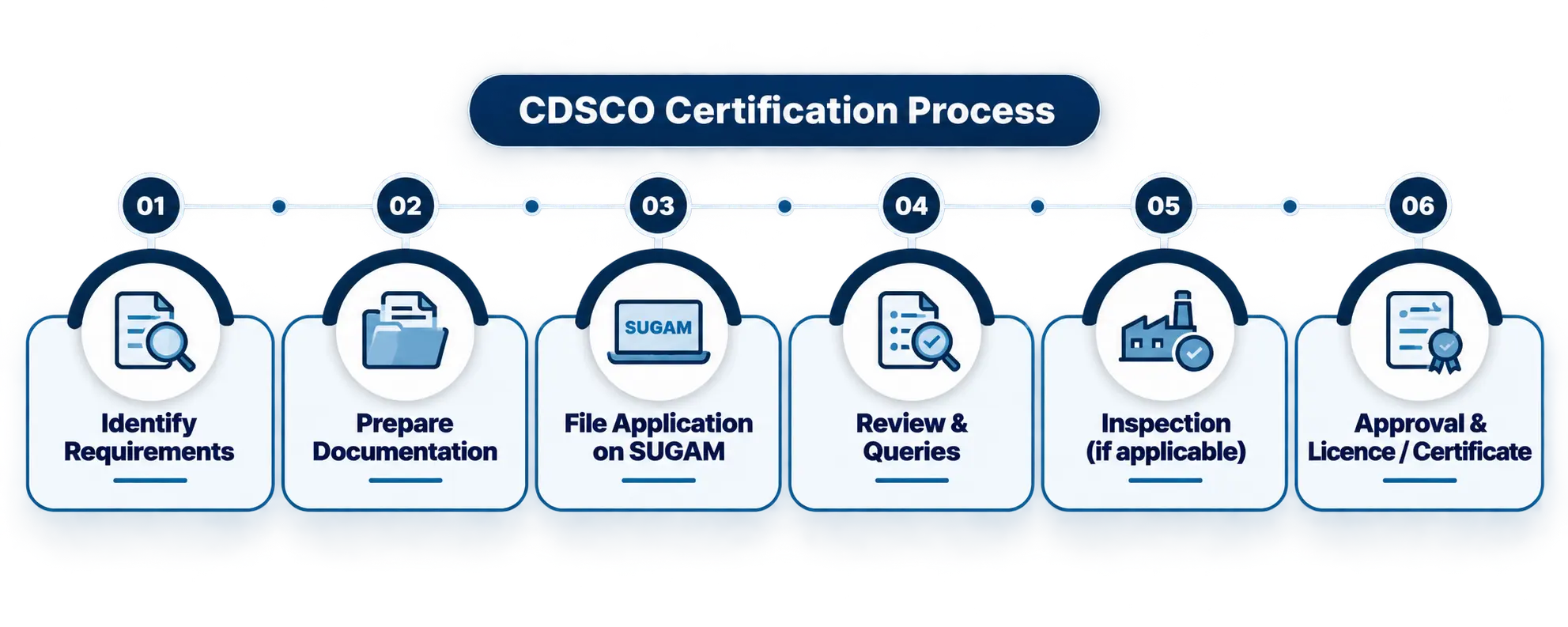
The exact steps vary depending on whether you're registering a drug, cosmetic, or medical device, and whether you're manufacturing or importing — but the overall structure follows a consistent pattern.
Step-by-Step Process:
-
Step 1: Identify the correct license category:
Determine which Act and Rules govern your product (Drugs and Cosmetics Rules for drugs, Cosmetics Rules 2020 for cosmetics, Medical Devices Rules 2017 for devices), and for devices, confirm the risk classification (A/B/C/D), since this decides whether you apply to the State Licensing Authority or the Central Licensing Authority.
-
Step 2: Prepare documentation:
Once your category is confirmed, compile your documentation set — company and manufacturing/import authorisation, product composition and intended use details, manufacturing site proof (GMP/ISO 13485 certificate or foreign manufacturing license), and for imports, a Free Sale Certificate, Certificate of Analysis, and compliant labelling. Foreign applicants also need a Power of Attorney for their Indian agent.
-
Step 3: Apply through the SUGAM portal:
Most CDSCO applications — import registration, device licensing, clinical trial approvals — are filed online through the CDSCO SUGAM portal, along with the prescribed application form (Form COS-1 for cosmetics, Form MD-14/MD-15 for devices, and corresponding drug forms) and the applicable fee.
-
Step 4: Document scrutiny and queries:
CDSCO reviews the application and supporting documents. It's common to receive a query or deficiency notice at this stage — missing lab reports, inconsistent product descriptions, or incomplete authorisation letters are the usual culprits. Responding accurately and quickly here has a big impact on how long the overall process takes.
-
Step 5: Inspection (where applicable):
For manufacturing licenses and higher-risk device classes, CDSCO or the State Licensing Authority may conduct a facility inspection to verify manufacturing practices, quality control systems, and record-keeping before approval.
-
Step 6: Approval and certificate issuance:
Once the application clears review (and inspection, if required), CDSCO issues the Registration Certificate or License, which specifies the approved product(s), manufacturing site, and validity period.
Documents Required for CDSCO Registration
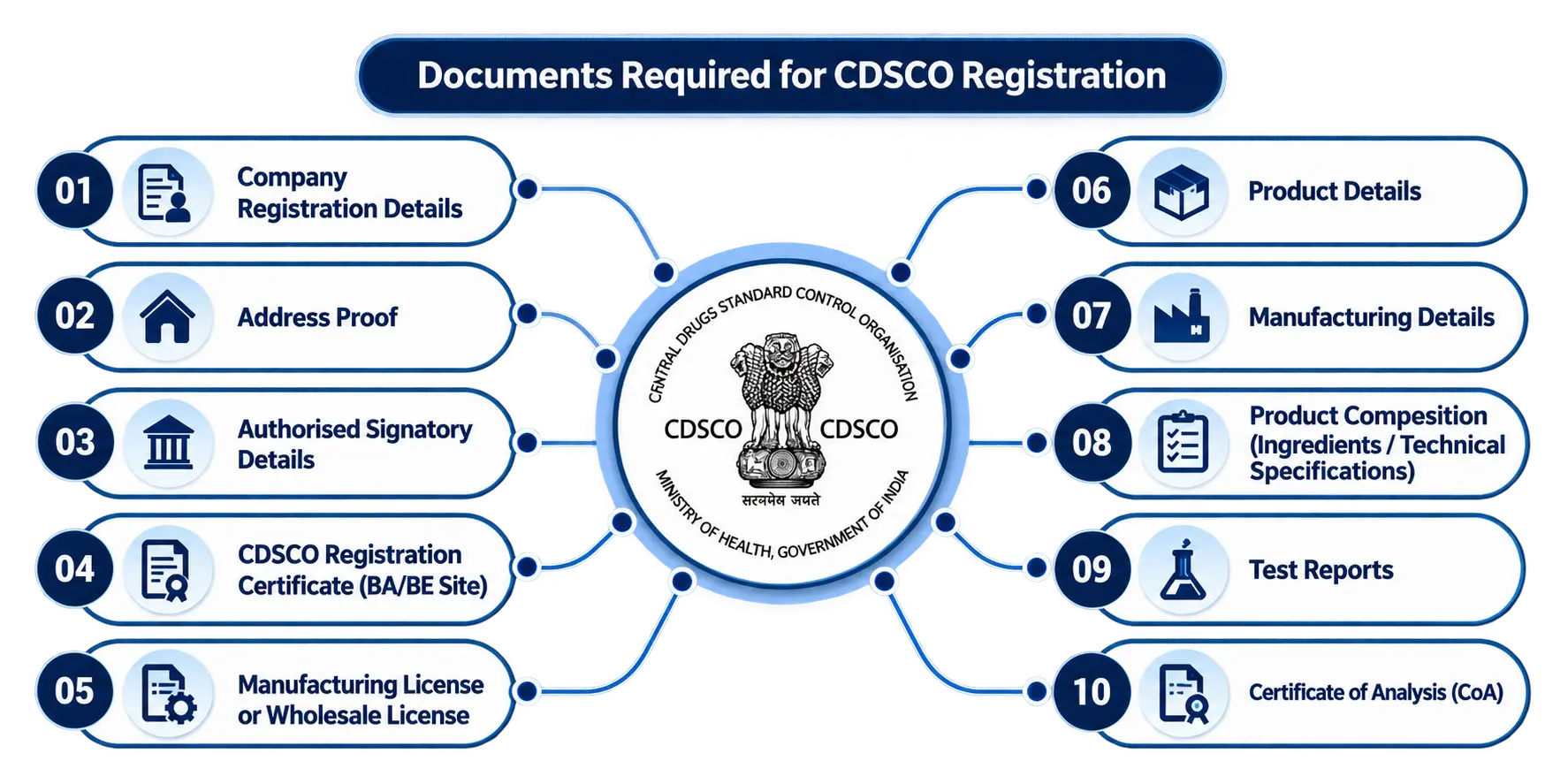
The important documents generally required for CDSCO Registration include:
Key Requirements:
- Company/Applicant Documents: Company registration details, address proof and authorised signatory details.
- Product Details: Product name, description, specifications and intended use.
- Manufacturing Documents: Manufacturing license and details of the manufacturing facility if manufacturing a product.
- Product Composition: Ingredients, formulation or technical specifications, as applicable.
- Test Reports: Applicable product testing and safety reports.
- Certificate of Analysis (CoA): Product analysis report, where applicable.
- Product Labels & Packaging: Proposed labels, packaging artwork and product information.
- Manufacturer's Authorisation: Authorisation or Power of Attorney from the manufacturer, where applicable.
- Quality/Certification Documents: GMP, ISO or other applicable certificates.
- Other Supporting Documents: Any declarations, undertakings or additional documents required for the specific application.
Note:The exact documents required for CDSCO Registration may vary depending on the product category, license/registration type, manufacturer or importer status, and applicable regulatory requirements.
Why is CDSCO Registration Mandatory?
CDSCO licensing, registration or approval may be required for medical devices, cosmetics and drugs in India, depending on the product category, its intended use and the activity being carried out. These requirements help ensure that regulated products meet applicable safety, quality and regulatory standards before they are manufactured, imported or marketed.
- Compliance with Applicable Regulations: Businesses must follow the regulatory requirements applicable to their products and activities. Medical devices are governed by the Medical Devices Rules, 2017, cosmetics by the Cosmetics Rules, 2020, and drugs by the Drugs and Cosmetics Act, 1940, along with the applicable rules and notifications.
- Product Safety and Quality: Applicable regulatory requirements help establish that products meet the prescribed standards for safety, quality, performance and labelling. The specific requirements depend on the nature of the product and the relevant regulatory framework.
- Authorization for Manufacturing or Import: Where a license, registration certificate or prior permission is required, businesses must obtain the applicable authorization before undertaking the regulated activity. For example, imported cosmetics require registration under the Cosmetics Rules, 2020, while drug and medical device imports are subject to their respective regulatory requirements.
- Avoiding Regulatory Non-Compliance: Failure to meet an applicable licensing, registration or product compliance requirement may result in regulatory action under the relevant law. The consequences depend on the nature of the violation and the provisions applicable to the product and activity.
- Supporting Market Readiness: Appropriate regulatory documentation helps businesses demonstrate compliance when dealing with importers, distributors and other business partners. However, CDSCO authorization does not automatically replace other approvals, registrations or standards that may apply to a product or business.
SS Global Services assists manufacturers, importers and businesses in identifying applicable CDSCO requirements, preparing documentation and navigating the relevant licensing, registration and approval process.
Who Needs CDSCO Registration?
CDSCO registration applies to a wider group of businesses than most people expect. You likely need it if you are:
- Drug manufacturers: Indian companies producing allopathic drugs, biologicals, or vaccines for the domestic market or export.
- Drug importers: Any business bringing finished formulations, APIs (active pharmaceutical ingredients), or bulk drugs into India for sale.
- Cosmetic manufacturers: Domestic producers of skincare, haircare, oral care, or personal care products.
- Cosmetic importers: Foreign or Indian companies importing cosmetic brands for the Indian market, including a single SKU test-launch.
- Medical device manufacturers: Companies producing Class A, B, C, or D devices in India, from simple disposables to implants and diagnostic equipment.
- Medical device importers: Businesses importing devices for distribution, hospital supply, or e-commerce sale.
- In-Vitro Diagnostic (IVD) manufacturers and importers: Diagnostic kits and reagents fall under the Medical Devices Rules and need equivalent registration.
- Clinical research organisations (CROs) and sponsors: Anyone conducting clinical trials for new drugs in India needs CDSCO permission before enrolment begins.
- Loan licensees and contract manufacturers: Businesses manufacturing under another brand's name still need the relevant license tied to the manufacturing site.
If your product touches human health - whether it's applied, ingested, injected, implanted, or used to diagnose - the question isn't really "do I need CDSCO registration," it's "which specific license applies to my product category."
Timeline for CDSCO Approval
The timeline for obtaining a CDSCO license, registration certificate or approval depends on the product category, type of application, applicable regulatory requirements and completeness of the submitted documents. Some applications have specified regulatory timelines, while others may require additional review, clarification or inspection.
| Application Type | Approval Timeline |
|---|---|
| Cosmetic Manufacturing License (COS-5 to COS-8) | 3-4 Months |
| Cosmetic Loan License (COS-6 to COS-9) | 3-4 Months |
| Cosmetic Import Registration (COS-1 to COS-2) | 4-6 Months |
| Drug Import License | 6-12 Months (Depends on drug category and approval route) |
| Medical Device Import License (MD-14 to MD-15) | 3-12 Months (Depends on Product Risk Classification) |
| Medical Device Manufacturing License (Class A/B) | 4-6 Months includes additional audit requirements |
| Medical Device Manufacturing License (Class C/D) | 6-12 monthsDepends on application and regulatory review |
| Drug Manufacturing License | 3-4 months days for applicable standard applications |
| Clinical Trial Permission | 3 Months |
| New Drug Approval | 10-12 Months (For certain applications; timelines depend on the applicable pathway) |
Note: The timelines above are indicative and depend on the applicable regulatory requirements, completeness of documentation, inspections and queries raised by the authorities. Actual approval time may differ depending on the product category and application type. Certain Class A non-sterile, non-measuring medical devices may be exempt from standard licensing requirements, subject to applicable conditions.
SS Global Services assists manufacturers, importers and businesses with CDSCO documentation, application filing and regulatory compliance to help streamline the approval process.
What Happens After CDSCO Approval?
Getting the certificate isn't the finish line - it's the start of an ongoing compliance relationship. Here's what typically follows:
- Validity and renewal tracking: Most CDSCO licenses and registrations are valid for a fixed period (commonly linked to the manufacturing license validity, or a set term for import registrations). Missing a renewal deadline can lapse your ability to legally sell, so this needs to be tracked proactively, not reactively.
- Post-market surveillance: CDSCO and state authorities can inspect facilities, pull samples, and monitor adverse events even after approval. Drugs and devices are subject to ongoing quality checks, and any deviation from the approved formulation, specification, or manufacturing process can trigger action.
- Adverse event and pharmacovigilance reporting: For drugs and certain medical devices, manufacturers and importers are expected to report adverse events through India's pharmacovigilance framework.
- Labelling and marketing compliance: Your packaging, labelling, and promotional claims need to stay consistent with what was approved. Changing a claim, adding a new use-case, or altering the formulation typically requires a fresh approval or amendment, not just a notification.
- Variation and amendment filings: Changes to manufacturing site, product composition, packaging size, or business ownership generally require you to file for an amendment to the existing license rather than starting from scratch - but it still needs to go through CDSCO.
- Import consignment clearance: With a valid Registration Certificate in hand, each shipment still needs to be cleared through customs referencing that registration, so keeping documentation organised and accessible matters for every import cycle, not just the first one.
Note: CDSCO approval gives you the right to operate, but staying compliant is a continuous responsibility renewals, reporting, and change management all need to be handled on time to avoid jeopardising a license you've already worked to secure.
Why Choose SS Global Services for CDSCO License?
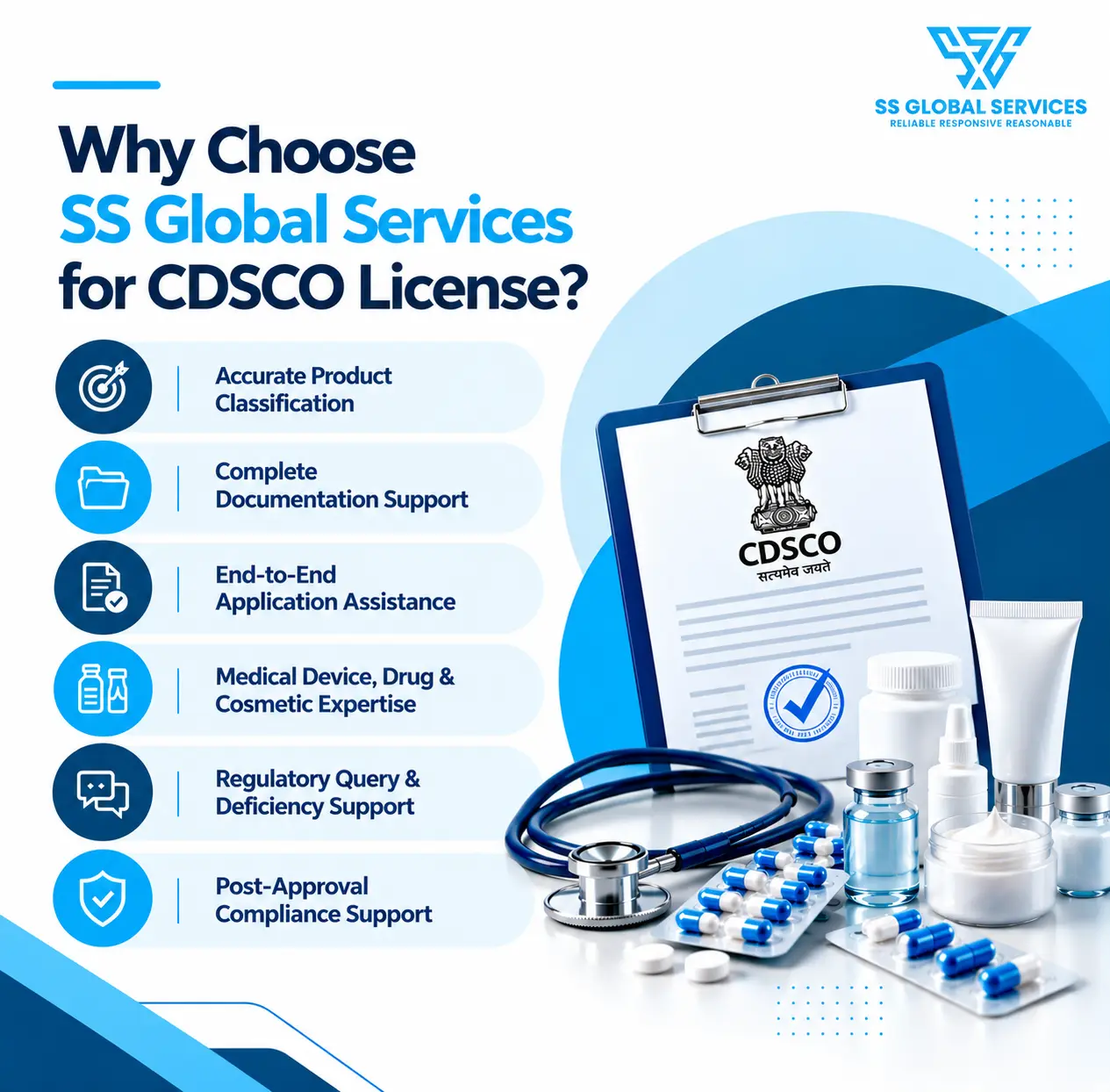
Obtaining a CDSCO license requires accurate documentation, correct product classification, and an understanding of applicable regulatory requirements. SS Global Services helps manufacturers, importers, and businesses navigate the process with professional guidance and end-to-end regulatory support.
SS Global Services works as your regulatory partner through the entire CDSCO journey:
-
Accurate product classification:
We identify the applicable product category and licensing requirements to help you start with the correct application.
-
Complete documentation support:
We assist with preparing and reviewing the required documents, technical files, test reports, and labelling requirements.
-
End-to-end application assistance:
From SUGAM portal filing to application tracking and follow-up, we support you throughout the process.
-
Medical device, drug and cosmetic expertise:
Get regulatory consultancy for all three product categories through one team.
-
Regulatory query and deficiency support:
We help address regulatory observations and prepare the required responses and supporting documents.
-
Post-approval compliance support:
We provide guidance on applicable renewals, amendments, and ongoing compliance requirements.
Our goal is straightforward: get your product legally market-ready without the back-and-forth, missed deadlines, or guesswork that usually stretches out CDSCO timelines. If you're planning to manufacture or import a drug, cosmetic, or medical device in India, talk to us before you start - it's the stage where the right guidance saves the most time.